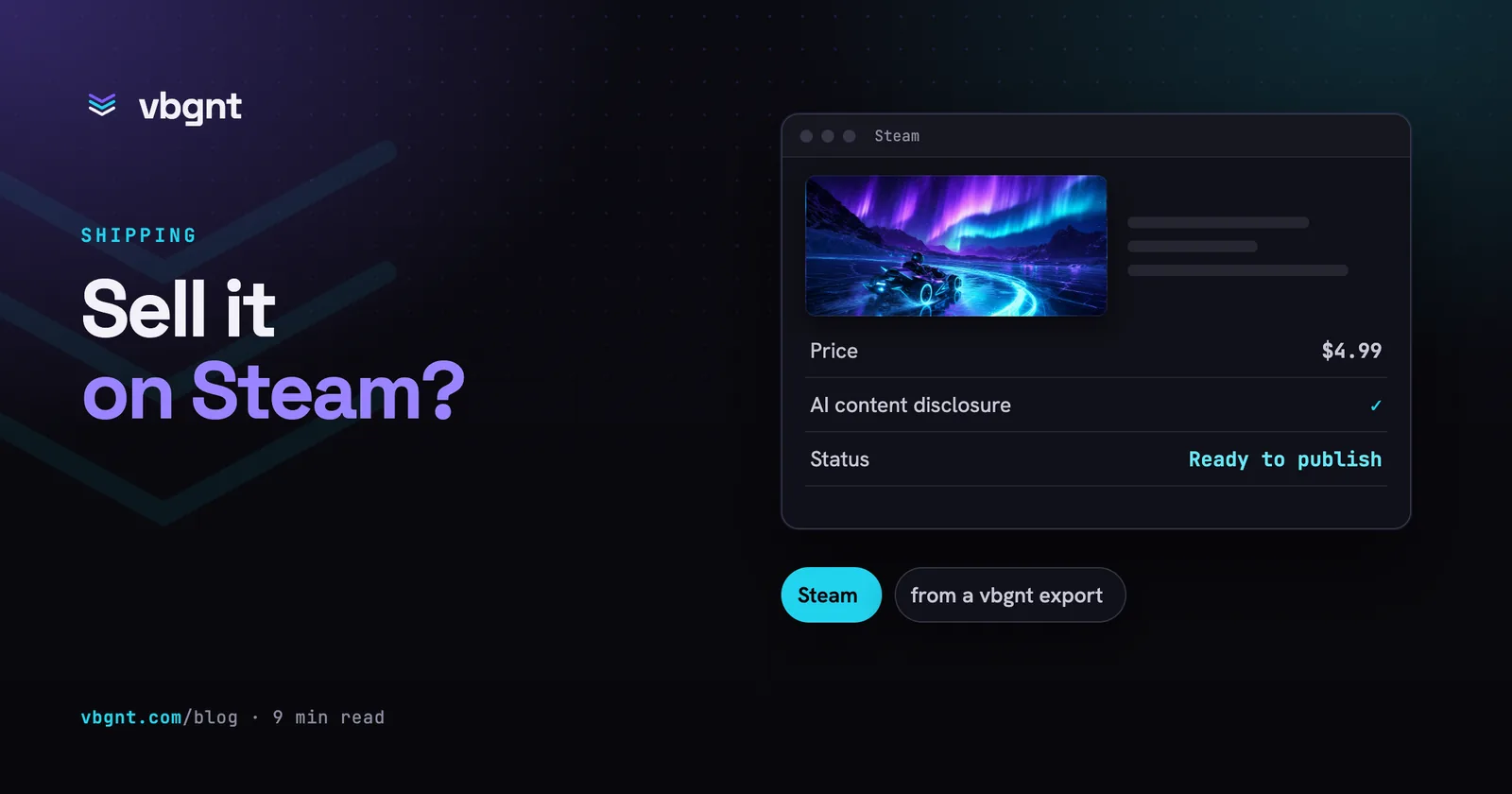
Yes. Steam has allowed games containing AI-generated content since January 2024, on one condition: you disclose it. The disclosure goes in the Content Survey when you set up your app, and a summary of it appears on your public store page where every prospective buyer can read it.
That is the short answer, and it has been stable for two and a half years. What changed in January 2026 is what counts as content you have to disclose, and the change is good news for anyone whose game was written with an agent.
What does Steam require you to disclose?
Valve's Content Survey splits AI use into two categories, and they carry very different obligations.
| Pre-generated | Live-generated | |
|---|---|---|
| What it means | Content made with AI during development and shipped as a fixed asset: textures, sprites, music, voice lines, dialogue, store art. | Content the game produces with AI while the player is playing: dynamic NPC speech, generated quests, real-time audio. |
| Human review | You saw it, approved it, shipped it. A human is accountable for every asset. | Nobody has seen the output. It is created for the first time on a player's machine. |
| What Valve asks for | A description of which kinds of content were AI-generated. | The same, plus a description of the guardrails you have in place to stop the game producing illegal or otherwise prohibited content. |
| Difficulty | Routine. A paragraph. | Genuinely demanding, and the reason to think hard before shipping a model that talks to players unsupervised. |
Almost every game from a generative studio is entirely in the left-hand column. The art was generated during production, a person looked at it, and it ships as a PNG like any other PNG. There is no model in the shipped build and nothing generated at runtime, so the live-generated obligations, which are the onerous half of this policy, do not apply to you at all.
Do I have to disclose AI if it only wrote the code?
On Steam, as of the January 2026 revision: no. Valve narrowed the disclosure requirement to content that ships in the game and is consumed by players, and explicitly set aside developer efficiency tools: coding assistants, editor automation, build tooling. The framework's own language is that efficiency gains from those tools are not the focus of the requirement.
This is a sensible line, and it took Valve two years to draw it. A player
experiences a texture. A player does not experience the process by which a
for loop came to exist, any more than they experience your
choice of IDE. Traditional procedural generation, the thing games have done
since Rogue in 1980, sits on the same side of the line and never needed
disclosing either.
Two caveats worth holding onto. First, the exemption is about code, not about everything an agent touched: if the same agent generated your sprites, that is pre-generated content and it gets disclosed. Second, this is Steam's line, not an industry standard. itch.io's disclosure form explicitly asks whether generative AI produced your graphics, sounds, text or code, and answers yes to any of them tag the page. Ship to both stores and you will truthfully fill in two different forms.
What happens if you don't disclose?
Non-disclosure is the actual risk in this entire subject, and it is avoidable for free.
The Content Survey is part of the review that gates your store page going live, so an inaccurate answer discovered during review costs you delays at minimum. Discovered after release, it is a policy violation, and Valve's available responses run through store page removal to delisting the app. Players do report games they believe are undisclosed, and there is now a large enough disclosed population that an undisclosed game stands out rather than blending in.
Over-disclosure, meanwhile, costs nothing. There is no penalty for ticking a box you were not strictly required to tick, and no reviewer has ever been annoyed by a developer who was too clear. If you are genuinely unsure whether something counts, disclose it and describe it plainly. The asymmetry here is enormous and it points in one direction.
How do players react to the disclosure?
Honestly: it depends on the game, and pretending otherwise would be useless to you.
The disclosure is public, it sits under About This Game, and a segment of players filters on it. Some will not buy a game with generated art on principle. That is a real cost and you should price it into your expectations rather than discover it in your first week of reviews.
What reliably makes it worse is being evasive. The pattern that generates backlash is not "this game used AI", it is "this game used AI and tried not to say so", or a disclosure so vague it reads as a dodge. A specific, matter-of-fact disclosure (background art and ambient music were generated with AI and edited by hand; all code, design and sound effects are human-authored) is read as confidence, because it is. The developers who get hurt by this policy are almost always the ones who tried to write around it.
The other thing that helps, unglamorously, is the game being good. A sharp mechanic with generated art gets a fair hearing. Generated art wrapped around nothing does not, and it would not have without the AI either.
Before you submit: a checklist
- Inventory what was generated. Go category by category (art, audio, music, voice, text, store page assets, Community items) and write down which used AI. Do this before you open the survey, not inside it.
- Confirm nothing generates at runtime. If there is no model in the shipped build, you are pre-generated only, and the guardrail questions do not apply.
- Write the disclosure in plain language. Name the categories. Say what was human-made. Two or three sentences.
- Check your marketing assets too. Capsule art and trailers are covered, and they are the ones people forget because they were made outside the project folder.
- Keep your other stores consistent. The rules differ; the facts should not. A game tagged "No AI" on itch.io and disclosing generated art on Steam is a problem you created for yourself.
None of this is difficult. It is one honest paragraph written before you need it, and it converts the single most avoidable way to lose a store page into a non-event. The rest of the work of shipping to Steam (the desktop exports, the $100 fee, the 30-day wait) is covered in our guide to publishing a vbgnt game on Steam, and it is all considerably more effort than this part.
Frequently asked questions
Does Steam allow AI-generated games?
Yes. Valve has allowed games containing AI-generated content since January 2024, provided you disclose it in the Content Survey when setting up your app. A summary of that disclosure appears publicly on your store page under About This Game, where prospective buyers can read it before purchasing.
Do I have to disclose AI if it only wrote the code?
On Steam, no. The January 2026 revision narrowed disclosure to content that ships in the game and is consumed by players, and set aside developer efficiency tools such as coding assistants and build tooling. The exemption covers code specifically, not everything the same tool touched: generated art and audio are still pre-generated content and are still disclosed. itch.io is different, and asks about generated code as well.
What happens if you don't disclose AI content on Steam?
The Content Survey gates your store page going live, so an inaccurate answer found during review costs you delays at minimum. Found after release, it is a policy violation, and Valve's responses run through store page removal to delisting. Over-disclosure carries no penalty at all, so when in doubt, disclose it and describe it plainly.
How do players react to an AI disclosure on a store page?
Some players filter on it and will not buy a game with generated art, and that is a real cost to price into your expectations. What reliably makes it worse is evasiveness: the backlash pattern is not that a game used AI, it is that a game used AI and was vague about it. A specific, matter-of-fact disclosure naming what was generated and what was human-made reads as confidence.
Is it legal to sell a game made with AI?
Yes. Selling a game built with AI tools is legal, and Steam, the App Store, Google Play and itch.io all list them. What each store asks for is disclosure: Steam's Content Survey, itch.io's generative AI tags. The obligations that remain are the ordinary ones: do not copy another game's characters, art or trademarks, and check that the tool you used grants you commercial rights to its output.