For about twenty years the interesting problem in entertainment was finding something. Catalogues outgrew any individual's capacity to know them, so we built recommendation engines, then editorial rows, then algorithmic feeds, and we called the whole apparatus discovery. An enormous amount of engineering went into the question what should I play tonight.
The premise underneath all of it was that making something was expensive and finding something was cheap. That was true for a long time. It isn't obviously true any more.
When creation gets cheaper than search
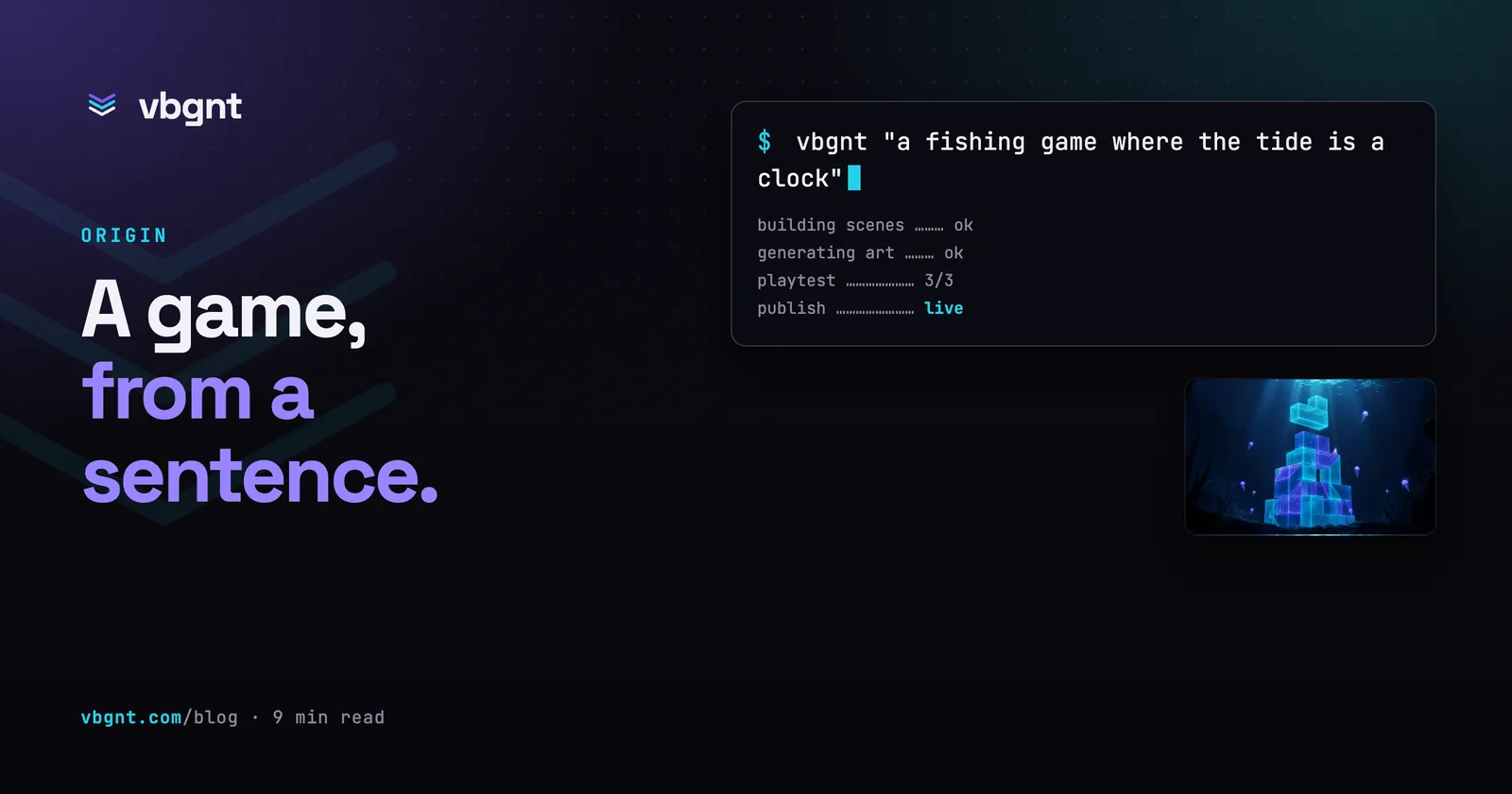
Consider the actual cost of an evening's browsing: fifteen or twenty minutes of scrolling, three trailers, two store pages, and a decision you're not confident in. Against that, a game generated to your specification in under fifteen minutes is not competing on quality: it's competing on fit, and it wins on fit by construction, because you specified it.
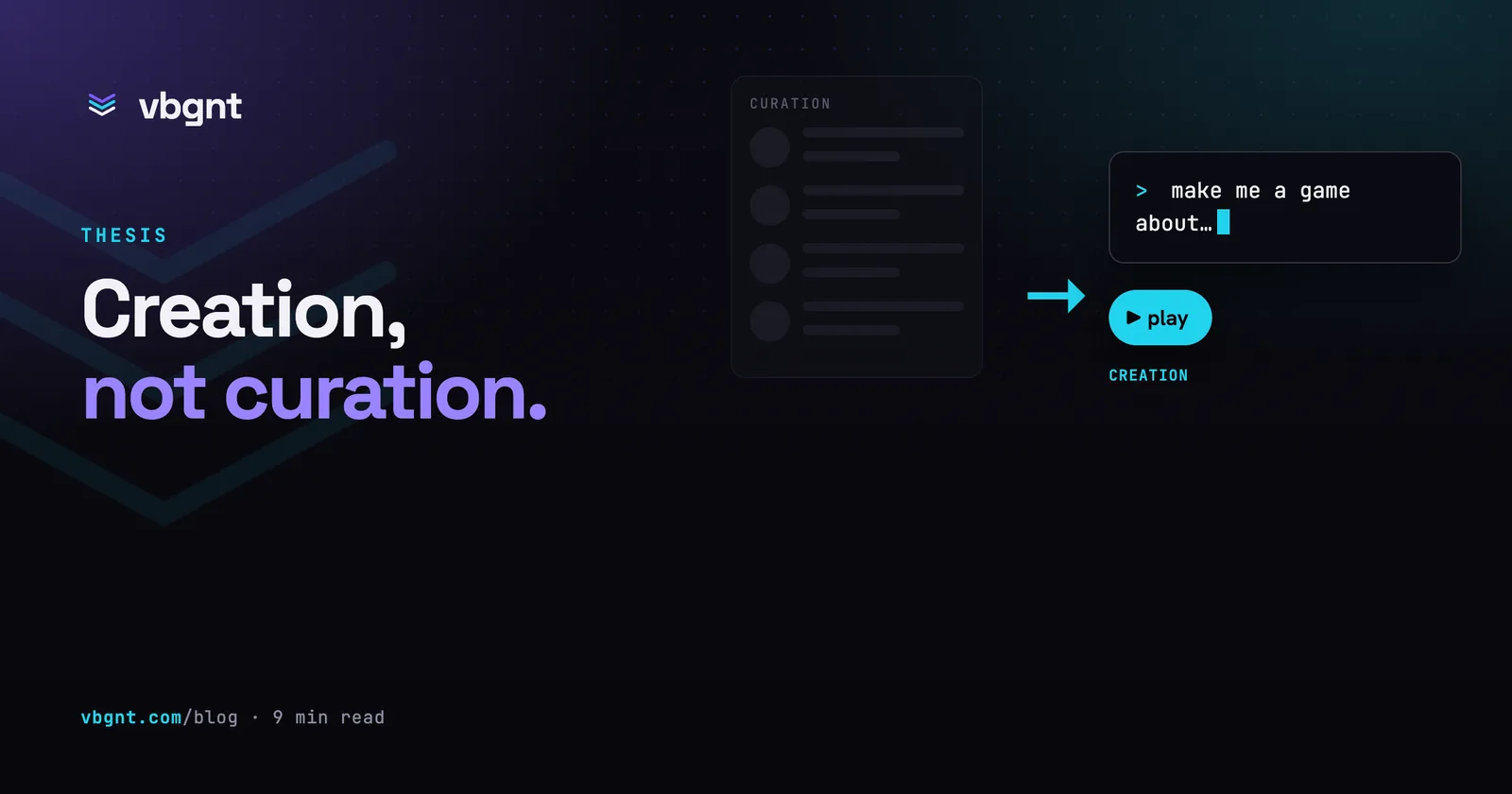
This is the inversion. Not "AI makes better games than studios": it doesn't, and that's a different competition entirely. It's that the search-versus-make trade flipped for a whole class of games, and once a trade flips, behaviour follows within a couple of years.
You can see the shape of it in adjacent media that got there first. Nobody searches for a specific meme any more; they make one. Nobody hunts for the right stock photo when they can generate the exact one. In each case the category didn't disappear: the default action changed, from retrieve to produce.
The player/creator distinction was always about cost
We talk about players and creators as if they were kinds of people. They were never kinds of people; they were positions on a cost curve. Making a game required months, a toolchain, and a set of skills that took years to acquire, so the people who did it were a separate population from the people who played.
Every time that cost dropped, the categories blurred: level editors, modding, Little Big Planet, Roblox, Dreams. Each one produced a generation of people who moved fluidly between playing and making, and each one was constrained by how much of the making it could actually automate. A level editor gives you levels. It doesn't give you a game.
Generative tooling removes the last expensive layer. What's left of the distinction is taste, and taste is not a profession.
What gets made that didn't before
The category that opens up is not "commercial games, but cheaper". It's games that were never worth making at all:
- A game about a private joke, playable by four people, funny for a week.
- A birthday present that takes two minutes to play and exists only for one person.
- A single mechanic you wanted to feel with your hands to find out whether it was interesting. It usually isn't. Now finding out costs a coffee break instead of a weekend.
- A teaching aid for one specific concept for one specific class.
- The pastiche of a genre nobody makes any more, generated on a whim, played once, remembered fondly.
These are disposable, and calling them disposable isn't a criticism. Almost everything humans make for each other is disposable: a meal, a playlist, a story told at a table. Games were the odd category where disposable was economically impossible, so we only ever got the monumental kind. That was an artifact of cost, not a fact about the medium.
What stays scarce
Three things, and it's worth being precise about them because "AI makes everything infinite" is the lazy version of this argument.
Taste. Knowing which single mechanic is worth building around, and being able to state it concretely. This is an editorial skill and it does not get automated by the thing that automated production: if anything it becomes the entire differentiator, because everyone now has the same production capacity.
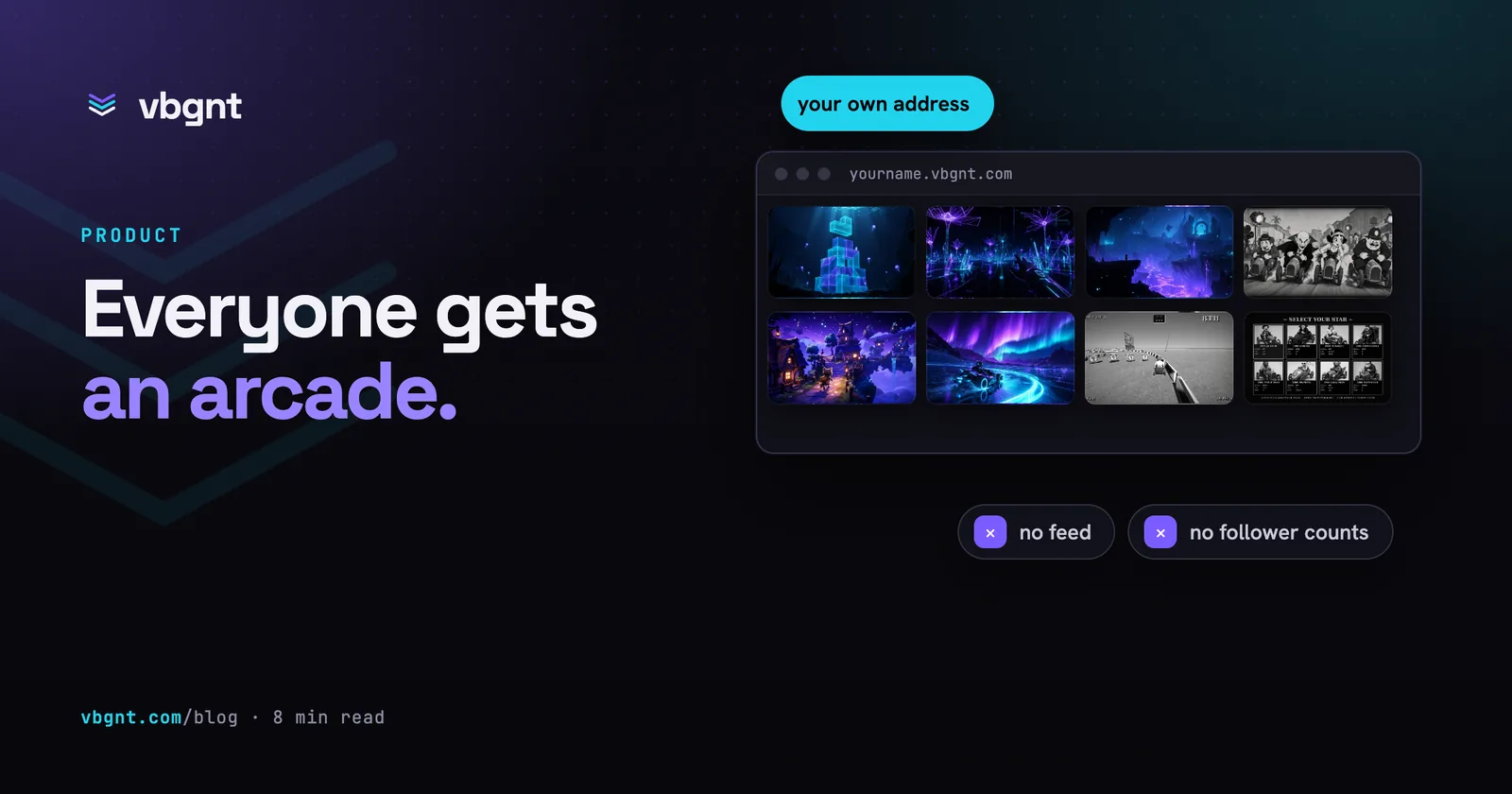
Attention. Making a game got cheaper; getting someone to play it did not. This is exactly why distribution shifts from feeds to personal links: when supply explodes, the trusted channel isn't a ranking, it's a person you know saying "play this, it takes ninety seconds".
Ensemble craft. The large, authored, decade-defining game made by three hundred people over four years is not threatened by any of this, in the same way restaurants weren't threatened by home cooking. It's a different product for a different occasion, and both get to exist.
The honest uncertainty
The bet here is that people want to make things and were mostly prevented by cost. That's plausible: every drop in creation cost so far has been met with more creation, not less, but it isn't certain. It might be that most people genuinely prefer to be told what to play, and that the making instinct belongs to a minority who were already finding a way.
The evidence so far reads the first way. Give people a machine that turns a sentence into something playable, and "I wonder if" quietly becomes a complete sentence: an idea that needs a coffee break instead of a justification. Whether that generalises past enthusiasts is the thing the next couple of years actually decide.
What already seems settled is the direction. The interesting question stopped being what should I play and became what should I make to play. Once you've asked it a few times, going back to scrolling a grid feels like using a card catalogue.
Frequently asked questions
Will AI-generated games replace studio-made games?
No, for the same reason home cooking did not replace restaurants. Large studio games are bets on scale, craft and ensemble production that a one-sentence brief cannot substitute for. What generative tooling replaces is the category of game that never got made at all: the specific, personal, small idea that was never worth a studio's quarter.
What skill matters when anyone can generate a game?
Taste, and the ability to describe it. When production is no longer the constraint, the difference between a forgettable generated game and a good one is knowing which single mechanic is worth building around and being able to say so concretely. That is an editorial skill, and it does not get automated by the thing that automated production.