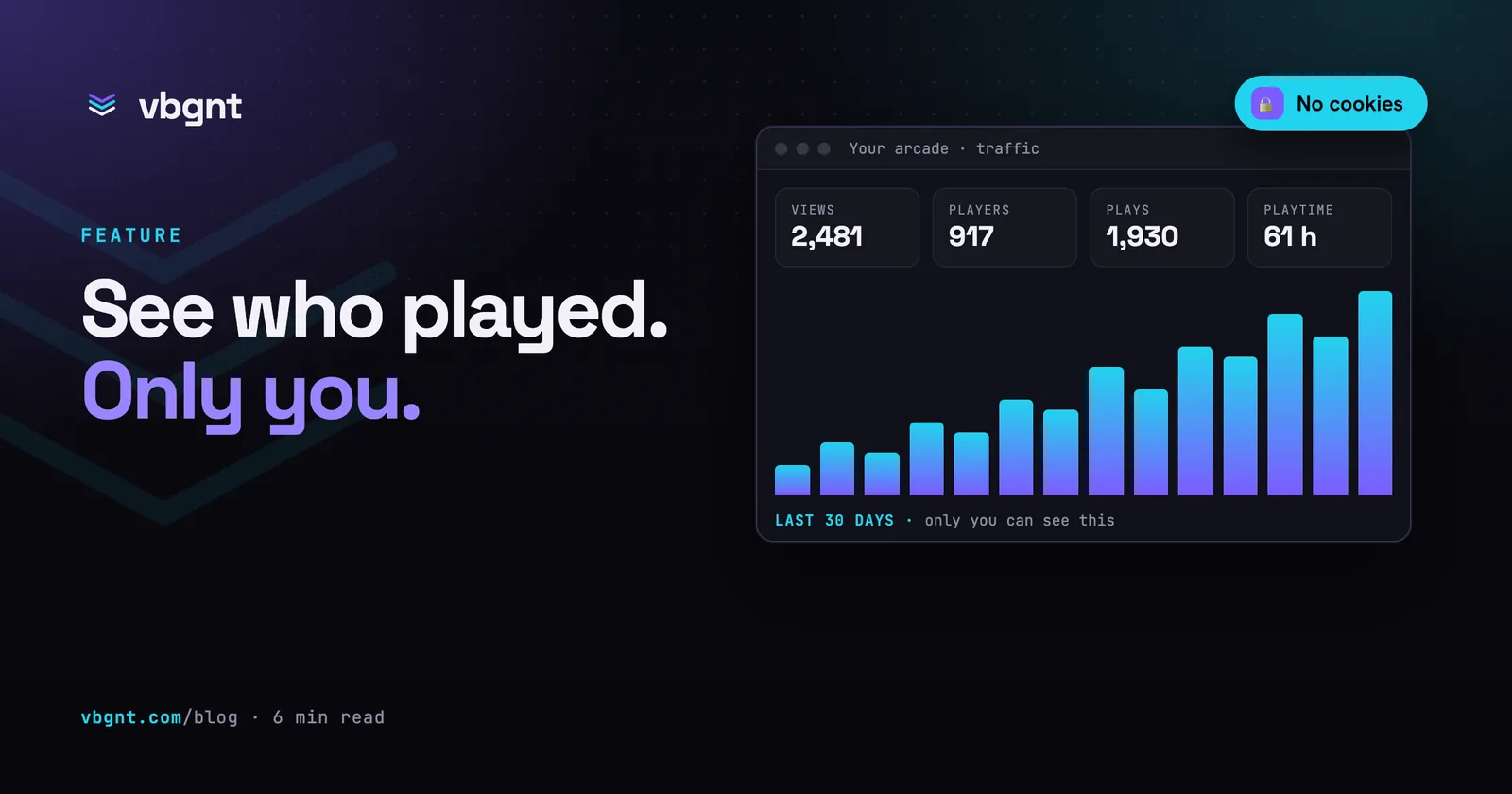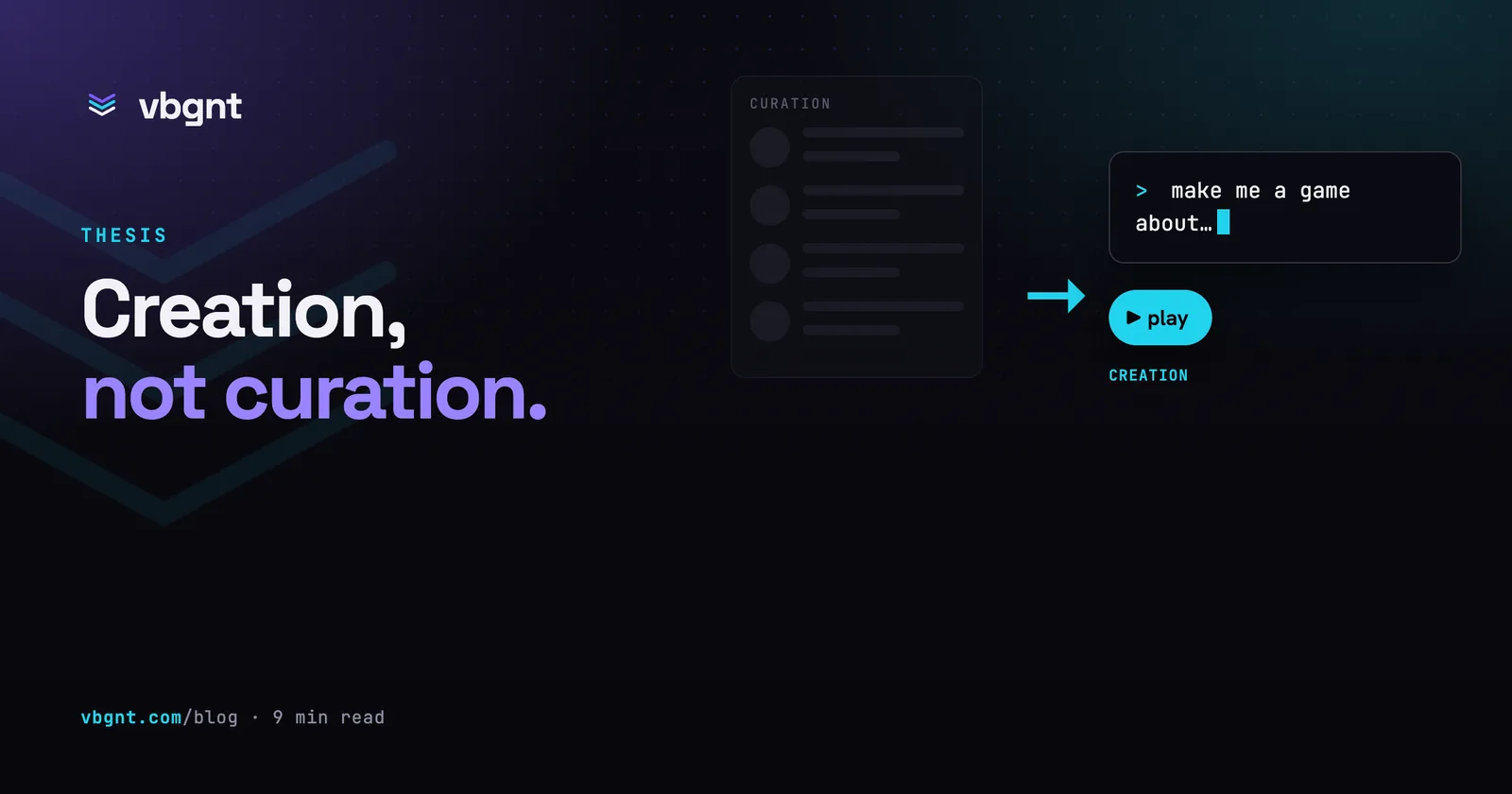
Every platform that hosts user-made things eventually builds a feed, and every feed eventually decides what gets made. Not through censorship: through incentive. Creators are perceptive, they work out what the ranking rewards within about a week, and from then on the ranking is a collaborator on everything produced there.
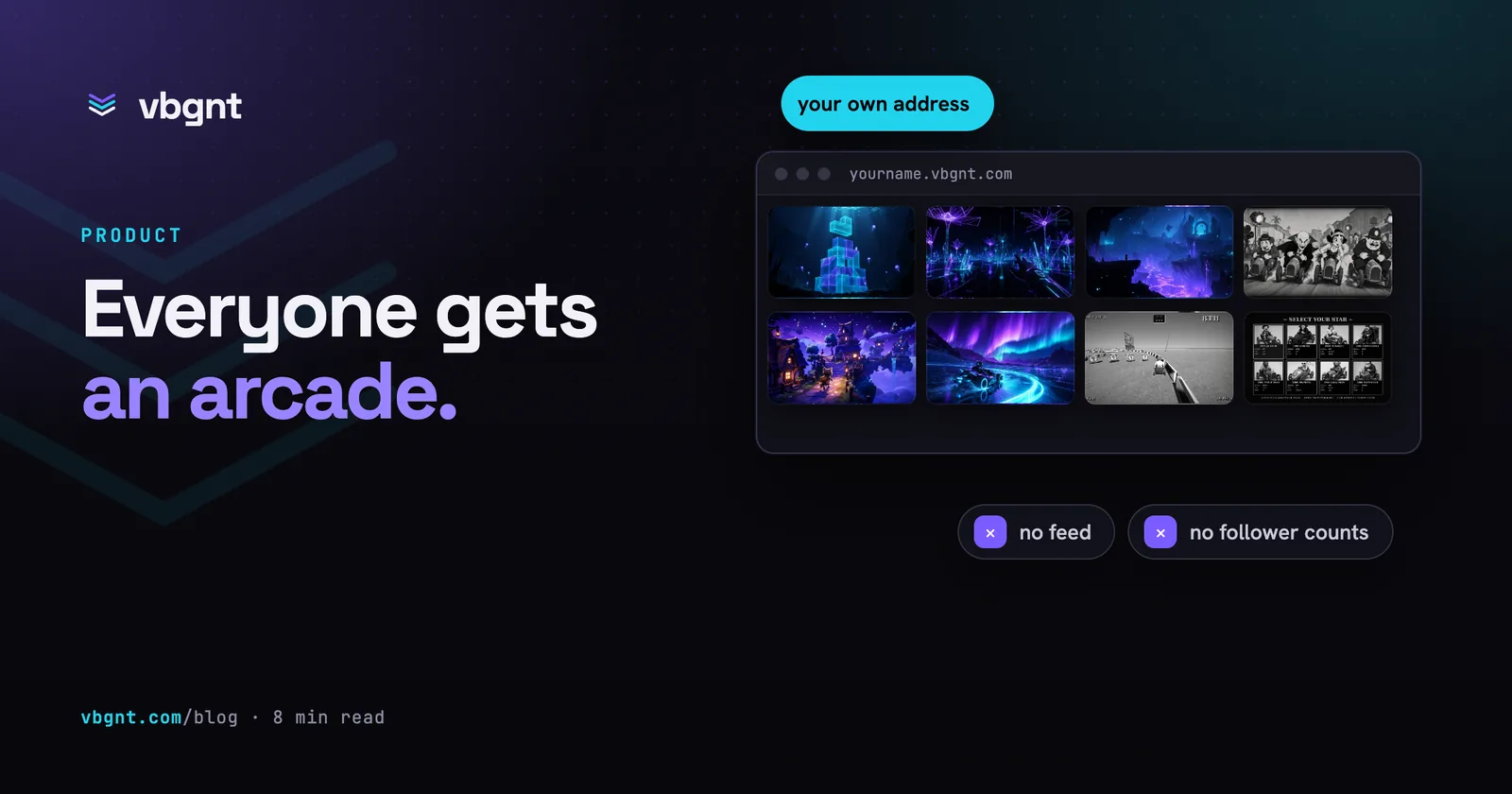
So this studio doesn't have one. Your games land at your own address, laid out like a console dashboard, and distribution is you sending someone a link. That's not a feature we haven't built yet. It's the shape of the thing.
An address, not a profile
A claimed handle becomes a real subdomain: yourname.vbgnt.com.
Not a path inside someone else's site, not a profile page with a platform's
chrome around it. The whole page is your arcade.
The difference is mostly psychological and entirely real. A profile page is somewhere you have an account. An address is somewhere you have a place. People treat the two differently: they'll put an address on a TV's home screen, in a bio, on a business card, in a QR code at a party. They put a profile link in a group chat once.
Handles are claimed once and permanent, which is the only way this works. The entire value of the URL is that it keeps working after it's been shared, bookmarked and forgotten about. A name that can be changed is a name that will eventually 404 for someone.
A ten-foot interface, on purpose
An arcade is not a file listing with cover images. It's built like a console dashboard, because a meaningful fraction of the time someone opens one it's on a television:
- A hero billboard, one game, large, with its art doing the work. Grids of equal-sized thumbnails make every game look equally optional.
- Horizontal shelves below it, the layout every console and streaming interface converged on, because it's what directional input navigates well.
- Spatial navigation: arrow keys, D-pad, gamepad, with a focus state you can see from across a room.
- Overscan-safe gutters and large type, so nothing important sits in the region a TV quietly crops.
Games open in place rather than in a new tab, so exiting a game returns you to the shelf you were on. On a controller that means holding Start, the gesture that has meant "get me out of here" for thirty years.
Deep links matter more than the front page
The realisation that changed the design: almost nobody shares an arcade. They share a game. "Play this specific thing, it takes ninety seconds" is the message people actually send, and it needs a URL that lands on that game with it already loading.
So every game has its own link, and following it opens the arcade with that game focused and running. The front page is where you end up after you've finished it: a natural second step rather than a toll booth you pass through first.
What we gave up by not having a feed
Being honest about the trade: no feed means no discovery. Nobody stumbles onto your game. There's no chance of it going anywhere on its own, no leaderboard, no trending row, no algorithmic second life for something made six months ago.
For a studio built around commercial games, that would be disqualifying. For one built around games made in an afternoon for a specific handful of people, it's the correct trade, and it removes the failure mode where the thing you made for your brother's birthday gets measured against strangers' metrics and found wanting.
There's a second-order benefit that took a while to notice. Without a ranking, the natural size of a game stays small. Nobody is trying to make the thing that wins the feed, so nobody is padding a twenty-minute idea into a two-hour one. Games stay the size they wanted to be.
Update, September 2026: the studio now has a games directory across all arcades. It lists only games their makers starred, one game at a time, and ranks them by plays; arcades themselves are unchanged. The post about it goes through how that sits with everything above.
Claiming a name
One handle per account, three to thirty characters, letters and numbers and inner hyphens: the constraints of a hostname label, because that's literally what it becomes. A short list of names is reserved: the ones that already resolve to something in the zone, and the ones an impersonator would want.
Because a claim is permanent, the claim flow is deliberately a little heavier than it needs to be. You are choosing the URL you'll be sending people for as long as you use this, and the five seconds spent thinking about it are the cheapest five seconds in the product.
Frequently asked questions
What is a vanity arcade URL?
A subdomain that belongs to one player and shows only their published games, yourname.vbgnt.com. It is claimed once and stays fixed, so the link keeps working after it has been shared, bookmarked or put on a TV's home screen. It behaves like a personal console dashboard rather than a profile page inside someone else's app.
Why is there no discovery feed or ranking?
Because ranking changes what people make. The moment a feed decides who gets seen, briefs start optimising for the feed instead of for the person who was going to play the game. A studio whose distribution is 'send someone a link' keeps the incentive pointed at making something a specific person will enjoy.