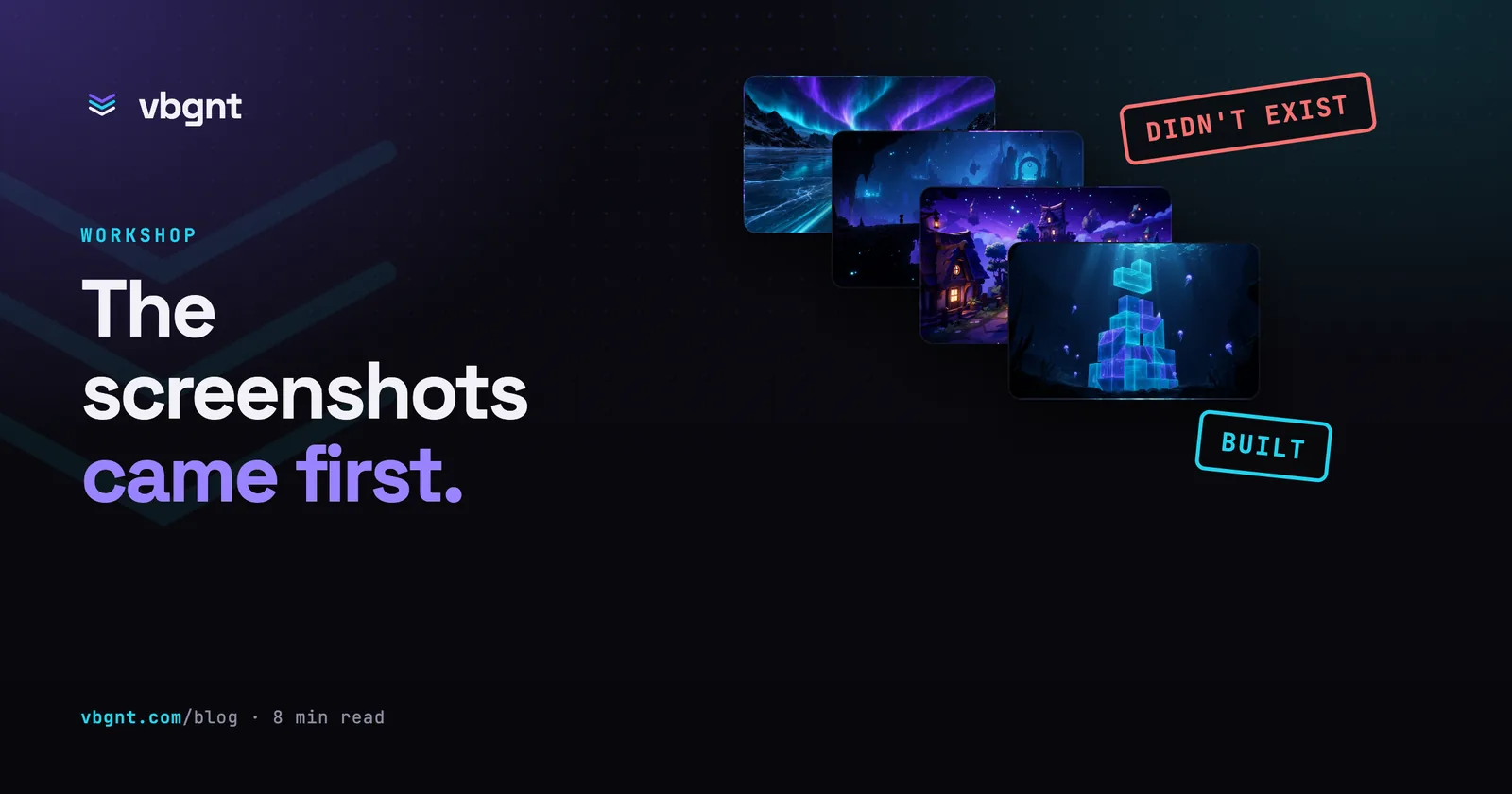
Every one of the five games on the vbgnt.com homepage was fake. Frostline GP, Ember Hollow, Tidepool, Nine Lives Mail, Static Garden: each existed as exactly one image, generated while the marketing site was being built, because a landing page for a game studio needs game art on it and the studio was still being wired together. This is normal practice and nobody apologises for it. Every product page you have ever scrolled shows screenshots of a version that does not quite exist yet.
Then the studio came online, and the screenshots turned into a dare. We had built a machine whose entire premise is that a described game becomes a playable game in minutes, and its own homepage was decorated with games that had never been described, let alone played. Keeping them fictional was either an oversight or a confession. So we ran our own marketing through the product: we had the same setup that made the concept art write a brief for each image, sent the five briefs through the studio, and published the results. They live at demo.vbgnt.com now, playable in a browser on whatever you are reading this on.
The pipeline ran backwards
The normal order of operations here is idea, then brief, then build, with cover art generated last, from a game that already exists. This time the cover art existed first and there was nothing behind it. The images had been made to a simpler specification than any game: look like something a person would want to play, in a palette that suits the site. The job was to work out what game each one was a picture of.
So instead of writing the briefs by hand, we handed the mockups back to the agent that had generated them and asked it to describe the game in each one, under the same rules we tell everyone to follow in the prompting guide: name one mechanic, state the camera and the control scheme explicitly, give the art direction as a period and a constraint rather than an adjective, and describe the first minute so the build opens with an on-ramp instead of a sandbox. Five images went in; five two-paragraph briefs came out, one per game, each short enough to paste into a chat box.
A picture is not a design
The exercise made one thing unmissable: a concept image radically underdetermines a game. The Nine Lives Mail art is a cat on a violet rooftop under cyan stars. Nothing in those pixels says that every delivery you complete lowers a bridge somewhere else in the village, or that the order you choose decides whether the whole route opens before dark. That mechanic arrived in the description step, and it is the entire game. The image contributed the twilight.
It held for all five. The Frostline GP mockup shows karts on cracked ice; the actual idea, that the ice fractures along the exact line every kart drives so the fast line on lap three is not the fast line on lap one, is nowhere in the frame. Ember Hollow's image is a silhouette holding a lamp, and the rule that you can hold the lamp or use your hands but never both, which is the whole spine of the game, had to be invented on top of it. So the honest description of this step is not "the descriptions were extracted from the images". The image fixed the mood and the palette. The brief invented the verb. In a generated game, as in any other kind, the verb is the game.
Locking the look with a reference
Each brief went into the studio as a new game with the original concept image attached as a reference, which tells the asset pipeline to treat the mockup as the style anchor rather than interpreting the written art direction fresh. That is what kept the aurora over Frostline in the same cyan and violet as the homepage, and Ember Hollow's cavern at three colours, and the demo arcade looking like the site that advertises it.
What the reference did not preserve, and could not, is geometry. The village in the playable Nine Lives Mail shares no actual rooftop with the village in the mockup; Tidepool's puzzles are not the puzzle in the picture. It turned out not to matter at all, which is worth knowing if you are ever tempted to chase a screenshot pixel for pixel. What a piece of concept art promises is a feeling, and the feeling survives a complete relayout. The screenshot was never a floor plan. It was a mood board with confidence.
The follow-ups did the usual work
First builds are drafts, and these five were no exception. The changes that turned them into the versions on the demo arcade were the ordinary kind, described by feel rather than by implementation: the ice cracking in Frostline should be audible before it is visible, the solved state in Tidepool needed a moment of payoff, Static Garden's rewriting should start subtle and get bolder the deeper you go. A few rounds each, in the same session that produced the first build, with the machine still warm. Nothing about being born from a mockup changed the iteration loop; the loop is where every generated game becomes worth playing, whatever the brief looked like.
What the demo arcade is for
demo.vbgnt.com is an ordinary player arcade, the same one every account gets: cover art, shelves, D-pad navigation, deep links to each game. It exists so that the marketing site can end in a link instead of a claim. Every sentence on a landing page is an assertion the reader has to take on trust; a link to the playable thing is the one part they can check.
And there is a general point underneath the stunt. A generative product can be asked to make its own marketing true, and the request is cheap enough that there is no excuse not to make it. If the studio had not been able to build the games its homepage showed, that would have been worth discovering before anyone else did. It could, so the mockups got promoted to screenshots, and the screenshots are now the least fictional thing on the page.
Frequently asked questions
Are the games on demo.vbgnt.com real?
Yes. All five are ordinary Godot projects generated by the vbgnt studio, exported to WebAssembly and published to a standard player arcade. They run in the browser on phones, desktops and gamepads with nothing to install. What makes their history unusual is the order: the cover art existed first, as mockups on the marketing site, and the games were built afterwards to match it.
Can AI turn an image into a game?
Not directly, and the demo arcade is a demonstration of why. An image fixes the mood, palette and setting, but it says nothing about what the player actually does, and that verb is the game. The working pipeline is image to written brief to build: describe the mechanic, camera, controls and first minute that the picture implies, then attach the image as a style reference so the generated assets match it.
Did the finished games match the concept art?
In palette, lighting and mood, closely: that is what attaching the original image as a reference buys. In geometry, not at all. The village in the playable Nine Lives Mail shares no rooftop with the one in the mockup, and no player has ever noticed, because what a screenshot promises is a feeling rather than a floor plan. Chasing a mockup pixel for pixel is effort spent on the part nobody experiences.
Can I play the demo games?
Yes, at demo.vbgnt.com, free, in the browser, with nothing to install. The arcade works with touch on phones, keyboard and gamepad on desktop, and D-pad navigation on a television browser. Each game also has a deep link, so you can send one game rather than the whole shelf.