Epic Games has told the team making its first Disney game to stop writing code by hand. Bloomberg's Jason Schreier reported on 12 October that the game, a shooter with Marvel and Star Wars characters, has slipped from its March release date. Its developers have been told it is now an "AI first" production: tools such as Anthropic's Claude do the work, and people manage and guide it.
We have an interest here. Every game in the vbgnt studio is made that way already: a coding agent writes the game, and a person tells it what is wrong. So here is what the report says, and what we have learned from working like this every day.
What did Epic tell its developers?
According to people familiar with the project, one of the game's directors told staff in an internal message that there would be "no more hand-written code", and that the game's art would come from AI workflows end to end. Epic's statement to Bloomberg says the company is "embracing AI-accelerated development", led by its developers as the creative drivers. Disney had not commented when the story ran.
The background matters:
- The money. Disney put $1.5 billion into Epic in 2024 for an equity stake and a multi-game partnership. This shooter was meant to be the first of those games.
- The cuts. In March, Epic said it was cutting 1,000 jobs, partly because Fortnite sales had slowed.
- The delay. Bloomberg's sources say the game has been slower than planned because Epic underestimated how many people and how much time it would need.
- The first. Bloomberg calls this the first time a major games company has tried to build a title primarily with AI.
The team did not take it well. On a video call last week, some developers were stunned. Some joked about whether they should just ask Claude to fix its own mistakes. Some hoped the request was not serious, or that Epic would back down. A survey Bloomberg cites found that more than a third of game developers use AI at work, and more than half think it is bad for the industry.
Can you really make a game with no hand-written code?
For the games we make, yes. A coding agent has written every game in the studio, more than fifty of them since July, 2D and 3D, most of them from a paragraph of description. So the instruction itself does not strike us as outlandish. Two caveats, though. Our games are small. And the code was never the expensive part.
The joke on Epic's call, asking Claude to fix its own mistakes, is close to how this actually works. What matters is whether the agent can see the mistake. Reading back its own code, an agent finds very little, because most game bugs do not live in the code. They show up when the game runs: audio that stays silent in the browser, touch input that whips the camera round, a 3D model facing backwards. An agent that can export the game, run it and read the errors fixes most of those before anyone plays. An agent that can only edit files passes them all to a person, and that person ends up as the test harness.
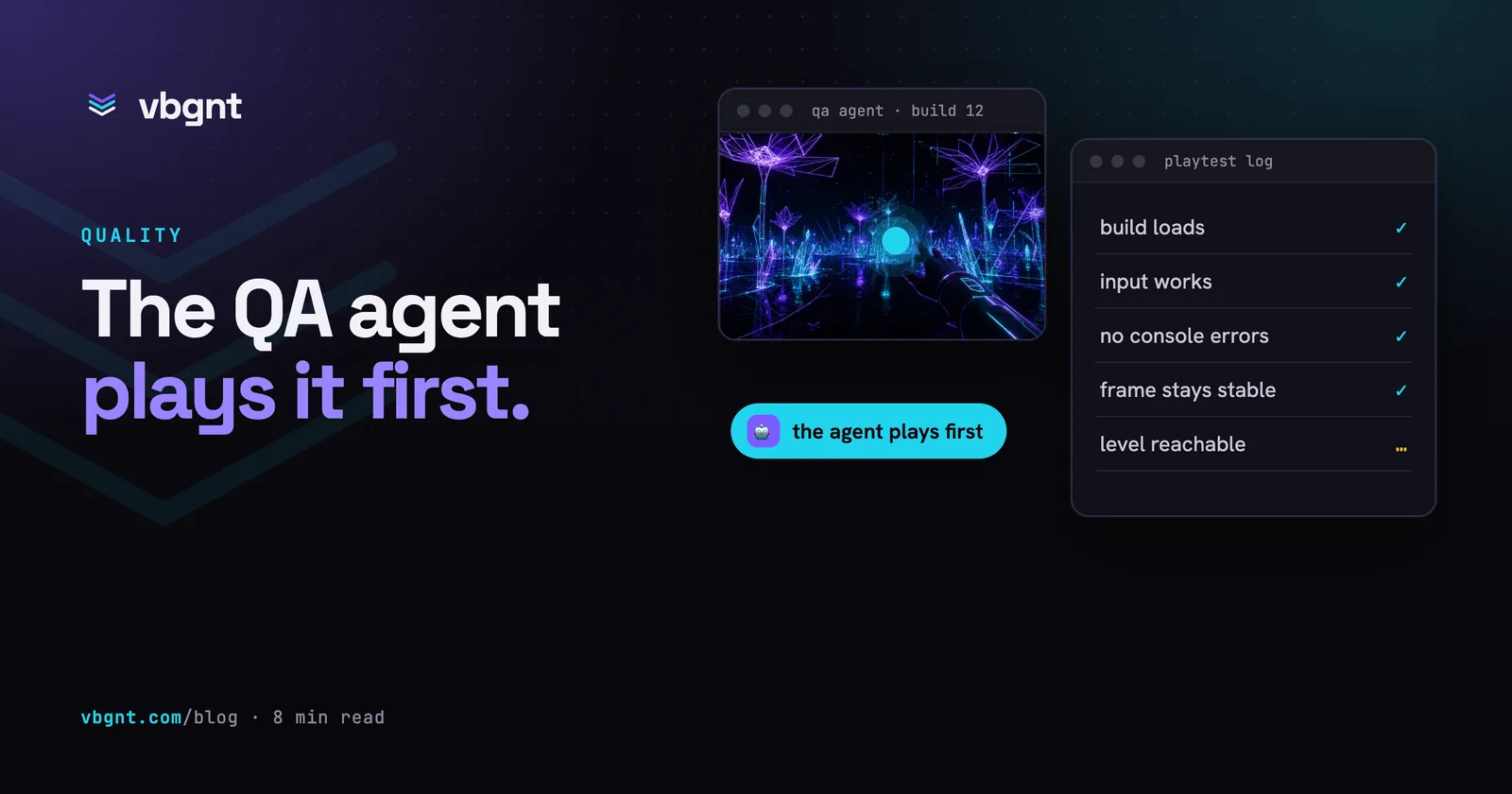
That is why every vbgnt build is played by a QA agent first, and why failures go back to the agent that wrote the code rather than to you. For an AI-first team, the question isn't whether Claude can write the code. It's whether the pipeline lets the agent run what it wrote, and who decides when the result is good enough.
What can't an AI-first team hand over?
Feel. An agent can make a jump. It cannot tell that the jump is floaty, because it has never held a controller. In a shooter, feel is nearly everything: recoil, hit feedback, how long it takes to go down, how the netcode hides lag. All of it gets judged by playing. Epic's statement describes its developers as the visionaries and creative drivers, and that is the right job description. In practice the job turns into playing builds and describing what is wrong precisely enough to fix. "The shot lands a frame after the sound" gets fixed. "Make it feel better" does not.
Scale. Our evidence comes from small games: one mechanic, a handful of systems, one person giving notes. Agents lose the thread once a change runs through many systems that depend on each other. A licensed shooter with two franchises, online play and a large team working in parallel is a different size of problem. Nobody has public evidence that an AI-first production works at that size, and we don't either. Bloomberg's sources blame the delay on Epic underestimating people and time, which suggests the bottleneck was never how fast anyone typed.
Sign-off. Marvel and Star Wars characters need approval from their owner, and that approval is a person at Disney looking at the work. A faster pipeline into a slow approval process makes for a longer queue, not a quicker game.
What about generating all the art?
Making one good image is easy. Making two hundred that look like the same game is the hard part, and most of the work in generated art is consistency: reference sheets, a fixed style prompt, and someone throwing out what does not match. For an original game, "close to the style" is the style. For characters with decades of model sheets behind them, close is not good enough, and that is probably where Epic's human hours will go.
One more difference: Epic has a licence. Anyone else generating those characters does not, and that is a line we hold in the studio. A game can borrow a genre, not a cast.
Why are Epic's developers worried?
Take them at their word. Players have been loud about AI-made content feeling cheap, and the developers on that call will carry the blame if the game ships feeling that way. A mandate that lands after 1,000 job cuts and a missed date will read as a cost decision to the people hearing it, whatever the intent.
Two things can be true at once. A coding agent can write a working game. And a large studio can switch to one badly: by announcing it rather than building the loop that makes it work, or by treating the people who judge feel as overhead. In our experience the person's job moves rather than disappears. They write the brief, play every build, and say no. In the vbgnt studio that person is usually one hobbyist making something on a weeknight. At Epic it is a team. How many people a game like that still needs is the open question, and this game will be the first public answer.
What does this mean if you make games?
The tools Epic is betting a Disney game on are the same ones a solo developer can use on a monthly subscription. At the size of a small game, the gap between a studio and one person narrows a lot, because the hard parts are the ones you already have: knowing what you want, playing it, and saying what is wrong.
If you want to try that way of working without a reorganisation, the studio is built for it. Describe a game, play the build, say what feels off, and play it again.
Frequently asked questions
What did Epic Games tell its developers about AI?
According to Bloomberg, Epic told the team on its upcoming Disney shooter that the game would be an "AI first" production built with tools such as Anthropic's Claude, with people managing and guiding the work. A director wrote that there would be no more hand-written code and that the art would be generated with AI workflows. Epic said it is embracing AI-accelerated development led by its developers.
Why was the Epic and Disney game delayed?
Bloomberg's sources say progress was slower than expected because Epic underestimated how many staff and how much time the game would need. The shooter, featuring Marvel and Star Wars characters, had been slated for March and was the first title in a multi-game partnership that followed Disney's $1.5 billion investment in Epic in 2024.
Can a game be made with no hand-written code?
Yes, at least for small games. Every game in the vbgnt studio is written by a coding agent from a description, with a person playing the builds and saying what is wrong. It works when the agent can export and run the game and read the errors itself. Whether it works for a large licensed shooter with a big team has not been shown publicly yet.
What parts of game development can AI not take over?
Feel, which is judged by playing; coordination across many interacting systems on a large project; and approval, such as a licensor signing off on its characters. An agent can write a jump or a weapon but cannot tell that it feels wrong, so the person's job becomes briefing, playing every build and describing problems precisely.