Yes, you can vibe code a game, as long as it is a small one. The evidence is two years of vibe coding games at jams: more than a thousand games entered the 2025 Vibe Jam with at least 80% of their code written by AI, and 945 entered the 2026 edition at 90%. Most of their makers had never made a game before. What vibe coding has not produced is a large game, and the reasons are specific to games rather than to AI.
Here is what vibe coding means, what it has actually made, where it breaks, and how to do it so that the game at the end works.
What is vibe coding?
Vibe coding is building software by describing what you want to an AI and accepting what it writes without reading the code. Andrej Karpathy named it on 2 February 2025: "There's a new kind of coding I call 'vibe coding', where you fully give in to the vibes, embrace exponentials, and forget that the code even exists." You judge the result by running it, not by reviewing it.
For games that is a better fit than it sounds, because a game is judged by playing it anyway. Nobody reads the source of a game they enjoy.
Is it possible to vibe code games?
For small games, clearly. The cleanest evidence is the Vibe Jam run by Pieter Levels. The 2025 jam required at least 80% AI-written code, a free web game with no login, and drew over a thousand entries. The 2026 jam raised the bar to 90% and drew 945 games and more than 240,000 players. One of the judges said of the 2026 winners that some were "getting close to be genuine games", which is a fair summary of the state of things: real, playable, short.
The best-known single example is Levels' own flight simulator, fly.pieter.com, built in a few hours in February 2025 with Cursor, Claude and Grok, which reportedly reached around $87,000 a month from in-game ads and paid planes within seventeen days.
The counter-evidence is just as instructive. In April 2026 a developer posted a post-mortem on the Godot forum of a metroidvania they spent about forty hours trying to vibe code, across several AI tools. Enemies and combat never worked, the assistants lost track of the code once a change touched more than two or three files, and a refactor the AI reported as finished had quietly left the logic where it was. Their conclusion was that vibe coding works for single-page web apps. That is too pessimistic, but it describes where the wall is.
What are the best vibe coded games?
- fly.pieter.com, the multiplayer flight sim that made vibe-coded games a business story.
- The 2025 Vibe Jam winners: The Great Taxi Assignment (gold), Vibeware (silver) and Vector Tango (bronze).
- The 2026 Vibe Jam winners: A Game About Capybaras Delivering Food (first), Fanto's Mega-Mart (second) and WenWare (third, and the most played), with Tiny Skies picked as the most polished and Null Range for its art direction.
All of the 2026 entries are playable in the browser from the jam's site. They are worth ten minutes if you want a calibrated sense of what vibe coding produces: short, inventive, rough at the edges, and mostly one idea done well.
Why are games harder to vibe code than apps?
Four reasons, and none of them is that the model writes worse game code than app code.
- Feel cannot be read off the code. An app is correct if the button does what it says. A game can be correct in every line and still feel wrong, and the AI has never held a controller. Someone has to play every build.
- Most game bugs only exist at runtime. A missing resource, a collision layer set wrong, a shader that does not compile in the browser: none of it shows in the source. An assistant that writes code without running it is guessing, and a vibe coder who does not read the code cannot catch the guess.
- Games are systems. Combat touches movement, which touches the camera, which touches the level. The metroidvania failed exactly where changes had to span several files at once.
- Games need assets. Art, sound and animation have to arrive at the sizes and formats the code expects. Vibe-coded games lean on primitives and free asset packs for a reason.
How do you vibe code a game that works?
- Keep it to one mechanic. The jam winners are small on purpose. Scope is the variable you control most.
- Pick a tool that runs the game. An agent that can execute the build and read the errors (Claude Code with a real engine installed, or a studio that tests every build) fixes the runtime bugs before you meet them. This is the single biggest difference between a vibe-coded game that works and one that does not. We wrote up how that loop works with Claude Code and Godot in Claude Code for game development.
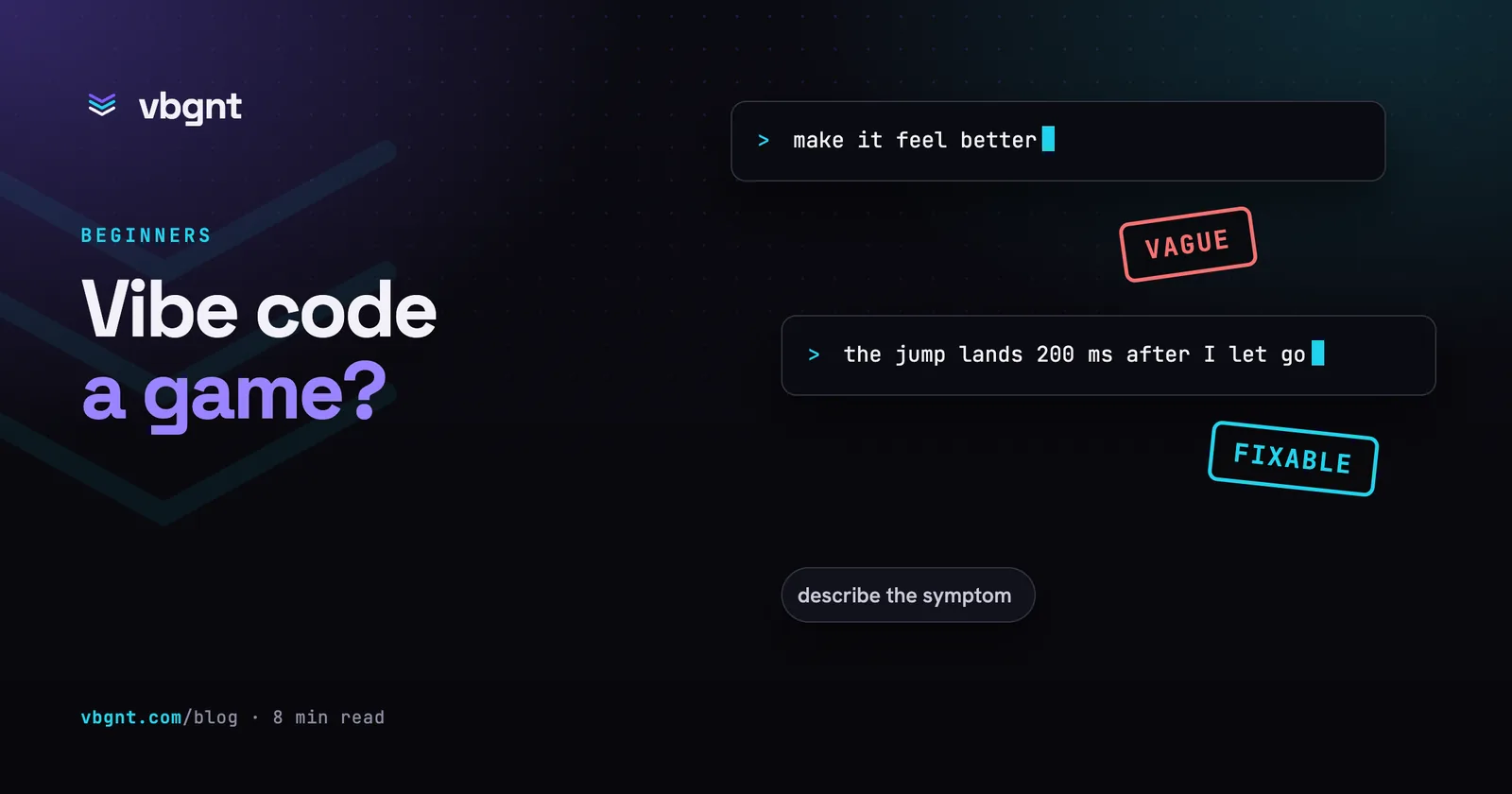
- Describe the symptom, not the fix. "The jump lands a moment after I let go" gets a better change than "increase gravity", because the agent can read the code and you are not reading it.
- Play after every change. Ninety seconds is enough. Vibe coding without playing is not vibe coding, it is hoping.
- Change one thing at a time. Batching six requests into one message means that when something breaks, you do not know which of the six did it.
- Keep a way back. Version control, or a tool with history, turns a bad change into a thirty-second revert instead of a lost evening.
The prompts that worked across 33 of our own games, in order, are in AI game development prompts.
Is vibe coding dead now?
The word is fading; the practice is not. A year after coining it, Karpathy called the original post a throwaway and suggested "agentic engineering" for the more careful version: agents doing the work, with a person checking it. That is a better description of how games actually get made with AI now, because the loop that works has a person playing every build. The 2026 Vibe Jam still drew 945 games.
Vibe coding or a studio?
Vibe coding with a general coding agent gives you complete control and complete responsibility: you choose the engine, you set up the assets, you host the result, and you find out the hard way which bugs the agent cannot see. A studio does the setup and the testing for you and leaves you the part vibe coding was always about, which is saying what you want and playing what comes back. vbgnt is one; its agent writes a Godot 4 project, tests every build in a headless browser before you see it, and publishes the game to a link you can send.
Frequently asked questions
Is it possible to vibe code games?
Yes, for small games. The 2025 Vibe Jam drew over a thousand web games with at least 80% of the code written by AI, and the 2026 edition drew 945 at 90%, most by people who had never made a game. Larger games with interacting systems remain hard: assistants lose track once a change spans several files, and most game bugs only show up when the game runs.
What are some of the best vibe coded games?
Pieter Levels' flight simulator fly.pieter.com is the best known. The 2025 Vibe Jam was won by The Great Taxi Assignment, Vibeware and Vector Tango. The 2026 jam was won by A Game About Capybaras Delivering Food, Fanto's Mega-Mart and WenWare, with Tiny Skies judged the most polished.
Is vibe coding dead now?
The term is fading rather than the practice. A year after coining it, Andrej Karpathy suggested agentic engineering for the more careful version, where agents do the work and a person checks it. The 2026 Vibe Jam still drew 945 games, and most AI-made games are now built that way: an agent writing code, a person playing every build.
What is the best tool to vibe code a game?
One that runs the game, not just writes it. Claude Code or Codex with a real engine such as Godot installed can export the game, read the errors and fix them before you play. Browser-first tools like Rosebud and Star are quicker for a first game, and a studio such as vbgnt adds generated art, automatic testing and publishing.