"Text to game AI" describes at least four unrelated technologies that produce four very different things, and the search results treat them as one category. That is why the demos look impossible and the free tools feel like toys: you are comparing a research system that renders frames with a website that fills in a template, and neither is what you thought you were clicking.
Here is the actual taxonomy, what each architecture can produce today, and the five questions that tell you which one you are looking at.
What does "text to game" mean?
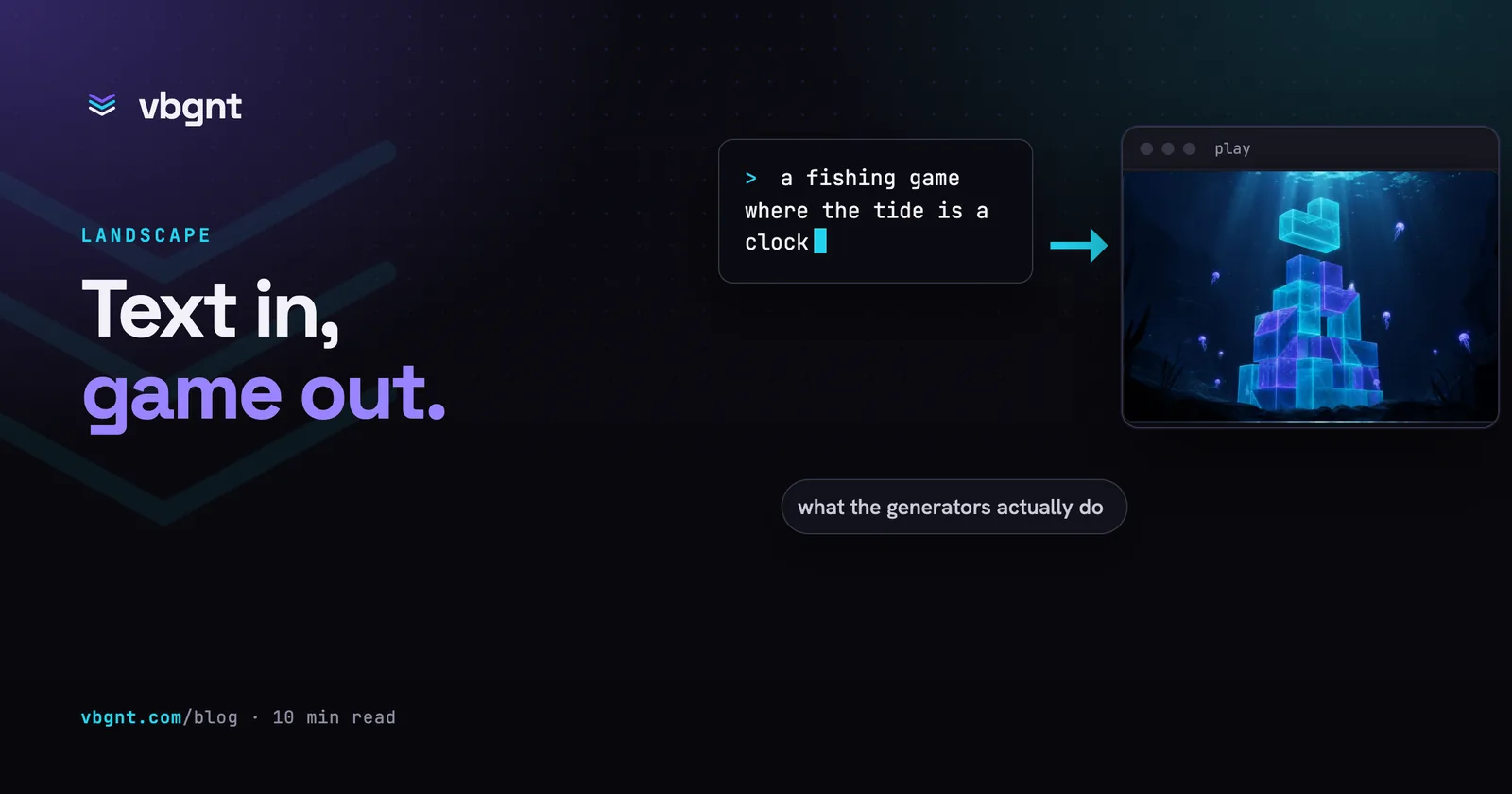
Four architectures, in increasing order of how much of a real game comes out the other end.
1. Chat that returns code
You describe a game to a general-purpose assistant and it writes you a script: a single HTML file, a Python file, a Godot node. This works, genuinely, and it is where most people's first generated game comes from.
What you get is source code. No art beyond coloured rectangles, no audio, no project structure, no build, and no guarantee it runs, because nothing ran it. For a mechanic prototype that is completely sufficient. For a game you send to someone, you are now the pipeline: you find the assets, you fix the errors, you host the result.
2. Template and remix generators
The bulk of the free "AI game generator" sites. Under the hood there is a finished game per genre and your prompt selects and fills parameters: the sprites, the names, the enemy stats, the level layout. Some are honest about this; most describe it as generation.
The output is real and it is playable immediately, which is the appeal. It is also bounded by the template in a way you will hit within about ten minutes of wanting anything specific, and typically it lives on their website, with no export and no source. Fine for a jam warm-up or a novelty. Not a foundation.
3. World models
The research systems behind the demos that look like magic, with Google DeepMind's Genie line the best known. These generate the game as video: a neural network renders each frame in response to your input, inventing the world as you move through it. There is no level, no code, no entities. There is a model imagining what should be on screen next.
They are the most astonishing thing in this field and the least useful to you today. Sessions are short, memory of what you already saw is limited, compute per player is enormous, and there is no artefact: nothing to export, edit, publish or sell. This is a preview of a future platform, not a tool for making a game this month. Judge the demos on their own terms and do not expect the free website you found to be doing anything remotely like it.
4. Agent plus a real engine
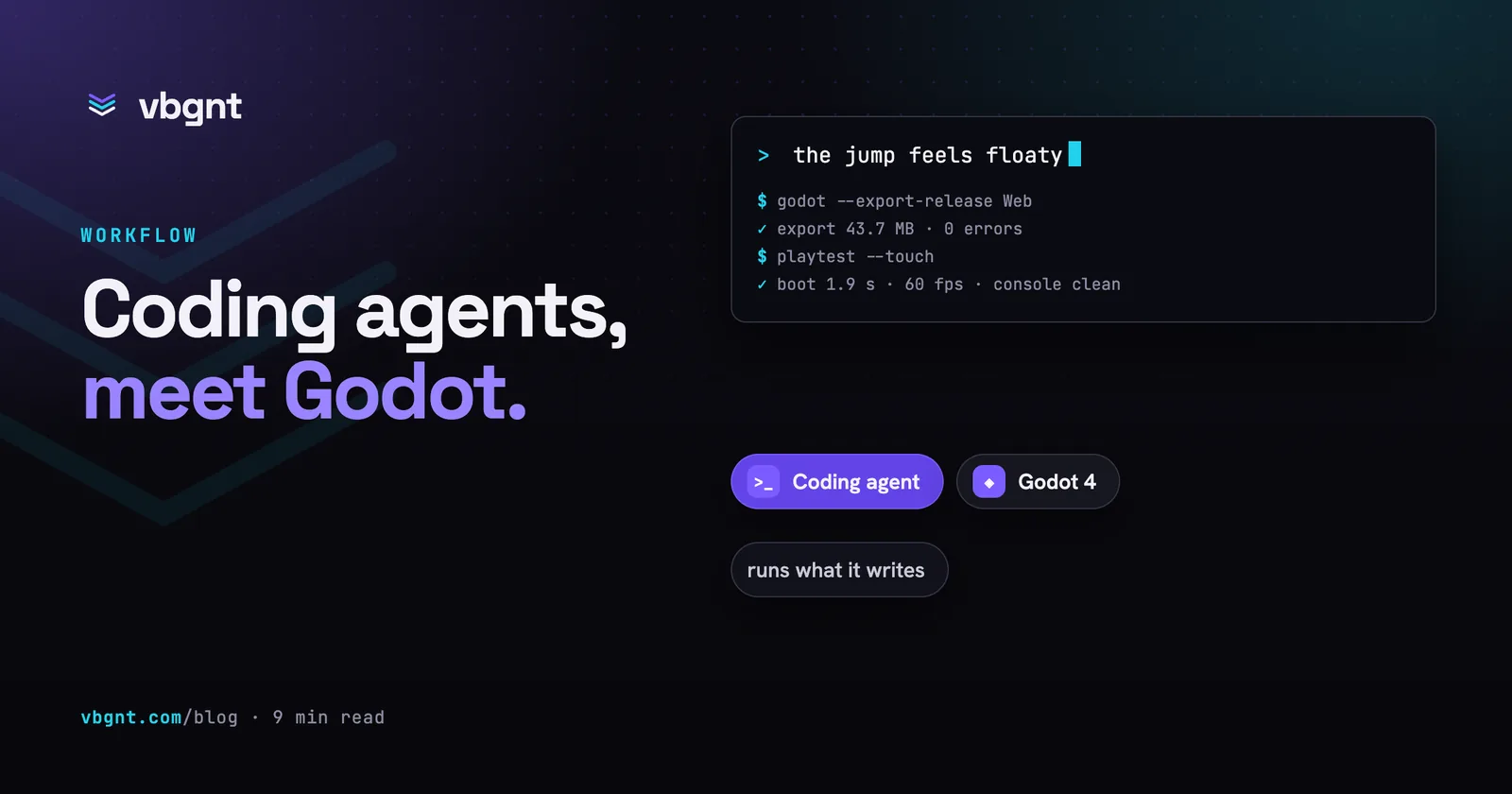
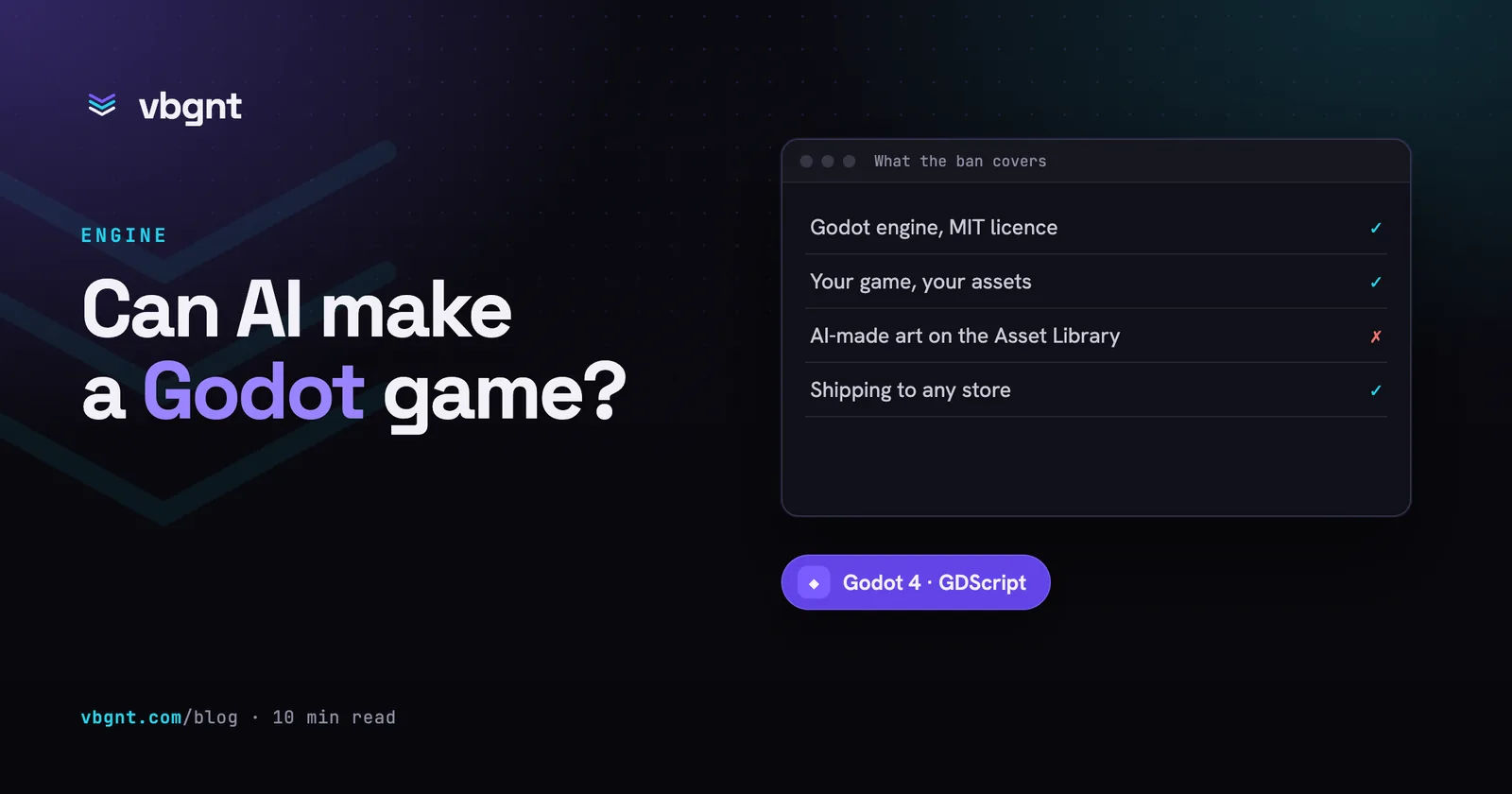
An agent with a real game engine installed (Godot, typically, for reasons covered in can AI make a Godot game) writes an ordinary project: scenes, scripts, an input map, imported assets, an export preset. It generates the art and audio, runs the export, and produces a build.
What comes out is a game project of the same kind a person would have made, which means it can be edited by hand, exported to a store, and owned. It is the slowest of the four to run and the only one whose output survives contact with the rest of the industry.
Can AI make a full game from one prompt?
It can make a full small game, and the adjective is doing real work.
What lands reliably from a single well-written brief: one core mechanic, a coherent art direction, a control scheme, a handful of levels or an endless loop, menus, sound, and a build that boots. That is a complete arcade-shaped game, and for a great many ideas it is the entire idea.
What does not land from one prompt: forty hours of content, a systemic game whose parts interact in ways nobody specified, narrative that holds together across acts, difficulty tuned by someone who played it two hundred times, or multiplayer. Those are not "not yet" in a way a bigger model fixes. They are authored, iteratively, by someone making thousands of judgements. A first generation is a strong draft. It is the beginning of the work, not the end of it.
The realistic loop is: describe, play for ninety seconds, react, describe again. Three or four passes gets you somewhere a single prompt never will, because after ninety seconds of play you know things about your own idea that you could not have written down beforehand.
Can ChatGPT make a game?
Yes, a small one, as code. Ask ChatGPT or any other AI chat app for a game and you get a working HTML or Python file for something like Snake, Breakout or a simple platformer, usually in one reply. What you do not get is art, sound, a tested build or anywhere to host it. That is architecture one above, and the gap between it and a finished game is everything after the code.
The gap closes when the same model is given tools. Put a coding agent in a directory with a real engine installed and it can run the engine, read the errors and fix them, which is a different job from writing a file and hoping. We wrote up what that looks like in practice in AI coding agents for game development, and why it still is not a studio on its own in what an AI game agent actually needs.
So the practical answers are: for a mechanic you want to try tonight, a chat assistant is enough. For a game you want to send someone, you need something that runs what it writes.
How to evaluate a text-to-game tool
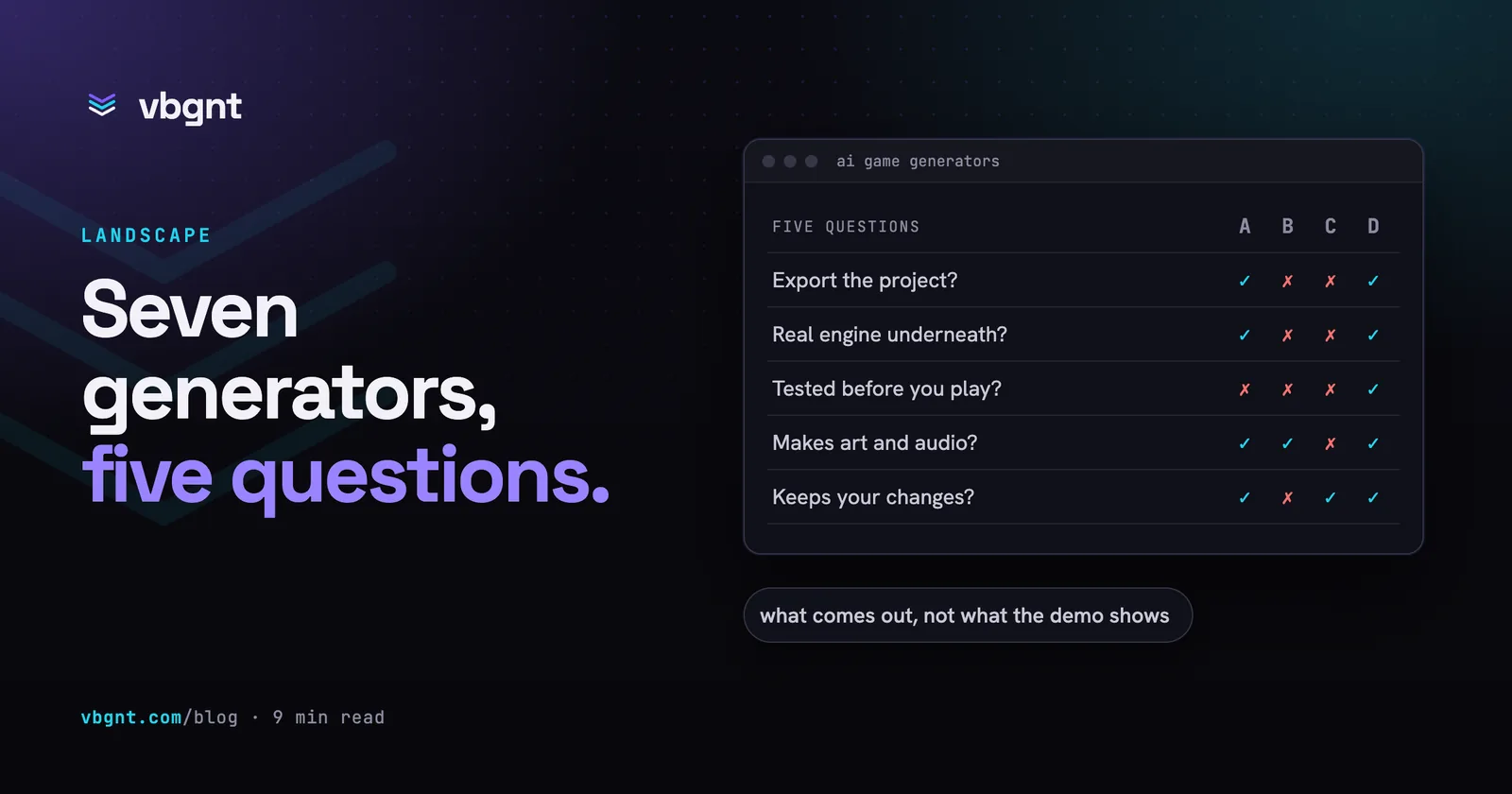
Five questions, in order of how much they matter. Every one of them can be answered before you invest an evening.
- Can you export the project? If the game only exists inside their website, you are renting it. This single question separates the tools worth building on from the rest.
- Is it a known engine underneath? A Godot or Unity project can be opened, edited by hand, and taken to a store. A proprietary format can be taken exactly nowhere.
- Did anything run the game before you did? Generated code that has never been executed fails at a rate that will surprise you. A studio worth using loads the finished build and plays it, checking that it boots, holds framerate and logs no errors, before handing it over. Ask whether it does.
- Does it generate assets, or just code? Art and audio are most of the perceived quality of a small game and most of the work. A tool that returns code has done a third of the job.
- What happens on the second message? Iteration is where games get good. If changing something means regenerating from scratch and losing everything you liked, the tool is a slot machine rather than a studio.
Questions one and three are the ones people skip and later regret.
We ran the tools that rank for "AI game generator" through these five questions in the best AI game generators, compared.
Are free AI game generators any good?
They are good for finding out whether you enjoy this, which is not nothing. Beyond that, the free tier of anything in this category is constrained in one of three predictable ways: a cap on how many generations you get, a template underneath that limits what can come out, or no export, so the game stays on their site.
The third constraint is the one that matters and the one least often disclosed on the pricing page. Before you spend a weekend on something, find the export button. If there isn't one, treat whatever you make as a sketch, and be happy with it as a sketch.
Do you own a game that AI made?
Mostly a question about the tool's terms, and secondarily about copyright law, and the two are often confused.
The terms are the practical part: read who owns the output and whether commercial use is permitted. Good tools give you the project outright. Some platforms retain rights, or grant you a licence to use a game that remains theirs, which is a materially different deal.
The legal part is narrower than headlines suggest. In the US, copyright attaches to human authorship, so output generated with no human creative contribution sits on uncertain ground as something you can register and defend. This does not stop you shipping or selling, since stores are fine with disclosed AI content, as covered in can you sell an AI-generated game on Steam, but it is a reason that the direction you gave, the choices you made and the editing you did are worth more than they look.
Where this actually is
Strip out the demos of things that are not yet products and the websites that are templates wearing a prompt box, and the honest state of text-to-game in 2026 is this: an agent with a real engine can take a sentence and hand back a small, complete, playable, exportable game in minutes, and then change it in response to how it felt to play. That is a smaller claim than the marketing in this category and a much larger one than most of the tools in it can meet.
It is also enough to change what an idea costs. When getting to a playable version takes ten minutes, you stop defending the first idea you had, and start finding out which of the twenty was worth making.
Frequently asked questions
Is there an AI that turns text into a game?
Yes, and there are four different kinds of it. A general assistant will write you game code with no art or build; a template generator fills parameters into a pre-made game of that genre; a world model renders playable-looking frames with no underlying code or exportable artefact; and an agent with a real engine installed writes an ordinary Godot or Unity project, generates its assets, and exports a build. Only the last produces something you can edit, publish and own.
Can AI make a full game from one prompt?
It can make a full small game from one well-written prompt: a single core mechanic, a coherent art direction, controls, a handful of levels, menus, sound and a build that boots. It cannot produce forty hours of content, a systemic game whose parts interact in unspecified ways, multi-act narrative, or difficulty tuned by someone who played it two hundred times. Treat a first generation as a strong draft and iterate from playing it.
Are free AI game generators any good?
They are good for finding out whether you enjoy the process. Beyond that, free tiers are constrained in one of three ways: a cap on generations, a template underneath that limits what can come out, or no export at all. The third is the one least often disclosed and the one that matters most, so find the export button before you spend a weekend on anything.
Do I own a game that an AI made?
The practical answer is in the tool's terms: read who owns the output and whether commercial use is allowed, because some platforms grant you a licence to a game that stays theirs. The legal answer is narrower than headlines suggest. In the US, copyright attaches to human authorship, so purely machine-generated output is uncertain ground for registration, but that does not stop you shipping or selling the game.
Can ChatGPT make a game?
Yes, a small one, as code. ChatGPT or any other AI chat app will write a working HTML or Python file for a simple game in one reply, but no art, sound, tested build or hosting. Given tools, the same models go further: a coding agent working in a directory with a real engine installed can run it, read its errors and fix them.