The best AI game generator depends on what you want to come out of it. For a game you can open in a real engine and take to a store, the choice is between the tools that run Godot (Tesana, and vbgnt, which publishes this blog) and GDevelop's AI agent. For a browser game you can share by link tonight, Rosebud and Star are the strongest. For a feed of tiny games on your phone, Astrocade. For code you will finish yourself, Replit.
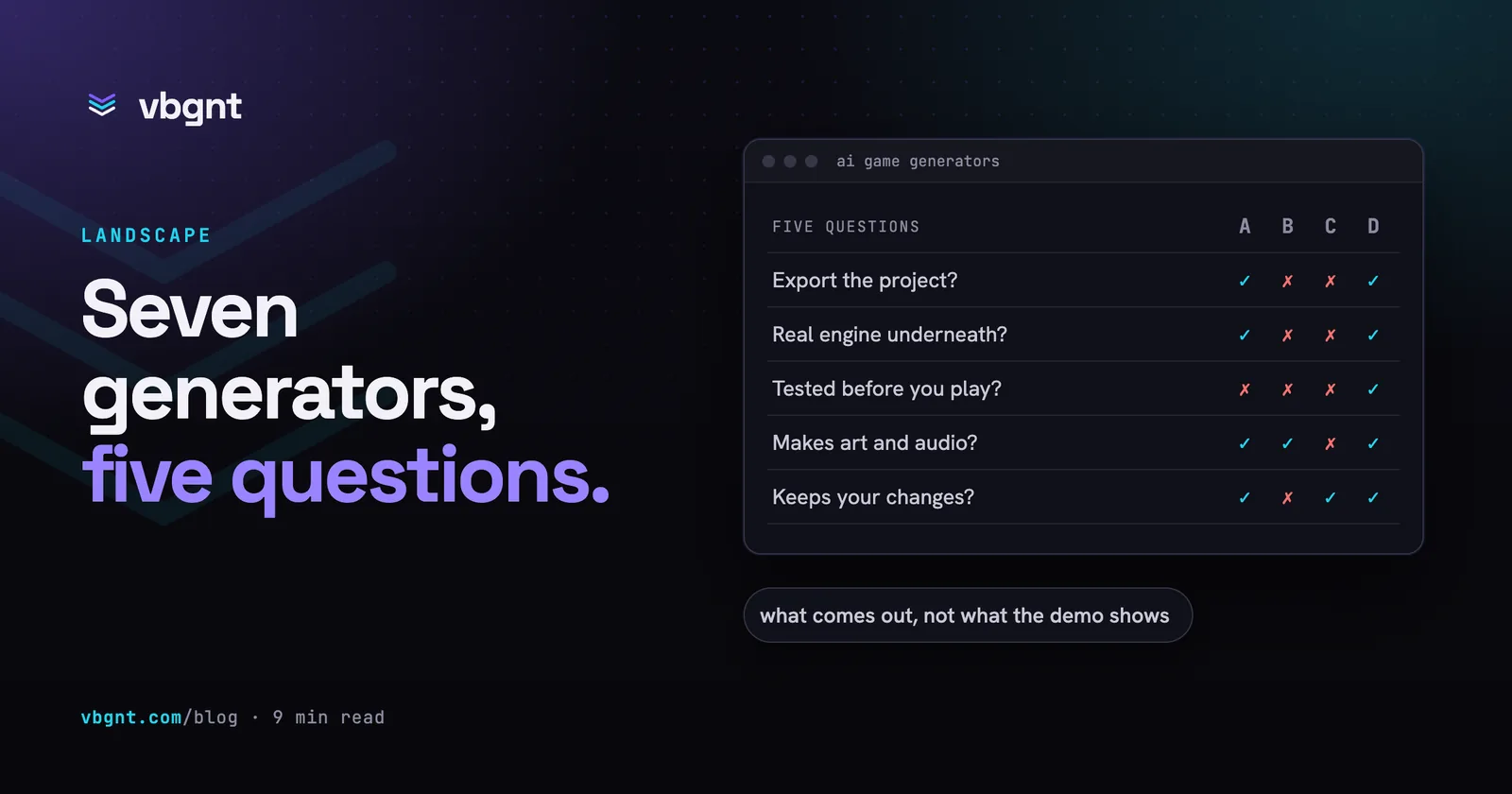
We make one of these tools, so read what follows with that in mind. To keep it fair, every tool is judged on the same five questions from what AI game generators actually do, and every price and feature below comes from the vendor's own pages as of 24 September 2026.
What is the best AI game generator?
| Tool | What comes out | Underneath | Can you export it? | Paid plans from |
|---|---|---|---|---|
| Rosebud | 2D and 3D browser games, shared by link | Three.js | JavaScript you can edit in the browser; code download from the $50 plan; Windows builds | $15 a month; free to start |
| Star | 2D and 3D browser games, with hosted multiplayer | JavaScript, Three.js for 3D | To itch.io, Windows or your own files; unbranded from the $50 plan | $20 a month; free to start |
| Astrocade | Short games in a scrolling feed | Browser (Three.js, Phaser) | No published export | Free |
| Tesana | 2D and 3D games with hosted multiplayer for 2 to 4 players | Godot | Web and desktop builds plus the Godot project, on paid plans | $25 a month; free daily credits |
| GDevelop | An AI agent that builds inside a no-code engine project | GDevelop (open source) | Yes: web, desktop, Android, iOS | $7.99 a month; free tier |
| Replit | Code for 2D web games in a general app builder | Whatever the agent writes | Full source as a zip or via GitHub | $20 a month; free tier |
| vbgnt | 2D and 3D games, tested and published to your own arcade | Godot 4 | The full Godot project, plus builds for web, Windows, macOS, Linux, Android and iOS | Invite-only; no public price list yet |
Two tools rank for "AI game generator" but make something else. Ludo.ai generates game assets (sprites, 3D models, music, sound, voices) and design documents, with small playable prototypes, for use in your own engine; plans start at $20 a month. Aippy and similar phone apps are feeds of mini games you make and play inside the app, with nothing to export.
How we compared them
- Can you export the project? A game that only exists on the vendor's site is a game you are renting.
- Is a known engine underneath? A Godot or GDevelop project can be opened and edited by hand. A bundle of generated JavaScript can be edited too, but nothing organises it for you.
- Did anything run the game before you did? Generated code that has never been executed fails often.
- Does it make the art and audio? Most of a small game's perceived quality, and most of the work.
- What happens on the second message? Iteration is where games get good; regenerating from scratch loses what you liked.
Rosebud
Rosebud builds browser games on Three.js from a description, with sprites, animations, skyboxes, 3D models and audio generated in the same flow, and publishes them to a link anyone can play. You can open and edit the generated JavaScript in the browser, and it claims multiplayer modes including co-op and PvP. It is the most established name in the category and the quickest route from an idea to something a friend can open.
The limits are the ones that come with a JavaScript target: there is no engine project to take elsewhere, and downloading the code needs the $50 Pro plan. Plans are $15, $30, $50 and $100 a month, priced in credits; commercial rights and removing Rosebud branding start at the $30 plan.
Star
Star (buildwithstar.com) is the most complete of the browser-first tools. It generates images, pixel art, sound effects, voices, sprite animations and rigged 3D models; ships touch, keyboard and gamepad controls with every game; and hosts multiplayer rooms on its own servers, so a match keeps running when the host closes their tab. It lets you pick the model, including GPT-6 Luna and several Claude models. Exports go to itch.io, Windows or plain files, unbranded from the $50 Pro plan. Plans are $20, $50 and $150 a month, and credit packs from $3 never expire.
Astrocade
Astrocade is a free platform where you make short games from a description and play other people's in an endless feed, with more than a thousand new games a day and an Android app with over a million downloads. Creators can earn based on plays. It is the most fun of these to browse. It publishes no export feature, so what you make lives on Astrocade.
Tesana
Tesana is the tool most like ours: it writes real code in a real engine, Godot, and generates 3D models, textures, audio, animation and effects. It hosts multiplayer servers for two to four players. On paid plans ($25, $50 and $200 a month) you can export standalone web and desktop builds and the complete Godot project, and sell the game elsewhere with no platform fee. The free plan has a daily credit allowance and is for personal, non-commercial use.
GDevelop
GDevelop is an open-source no-code engine with an AI agent built in. You ask it to build a feature or start a game, and it plans the work and then creates objects, behaviours and events inside a normal GDevelop project, which you can keep editing by hand in the visual event system. That makes it the best choice here if you want to learn to make games rather than only have one made. It exports to the web, desktop, Android and iOS, and includes lobbies for online multiplayer. The free plan includes 40 AI credits a month; paid plans run from $7.99 to $39.99 a month.
Replit
Replit's Agent is a general app builder that also makes games: describe one and it writes the code, typically for 2D web games. You get the full source as a zip or a synced GitHub repository, which makes it a good start for a programmer who plans to finish the game themselves. It does little asset generation, and the free plan's one published app goes offline after 30 days. Paid plans are $20 and $100 a month.
vbgnt
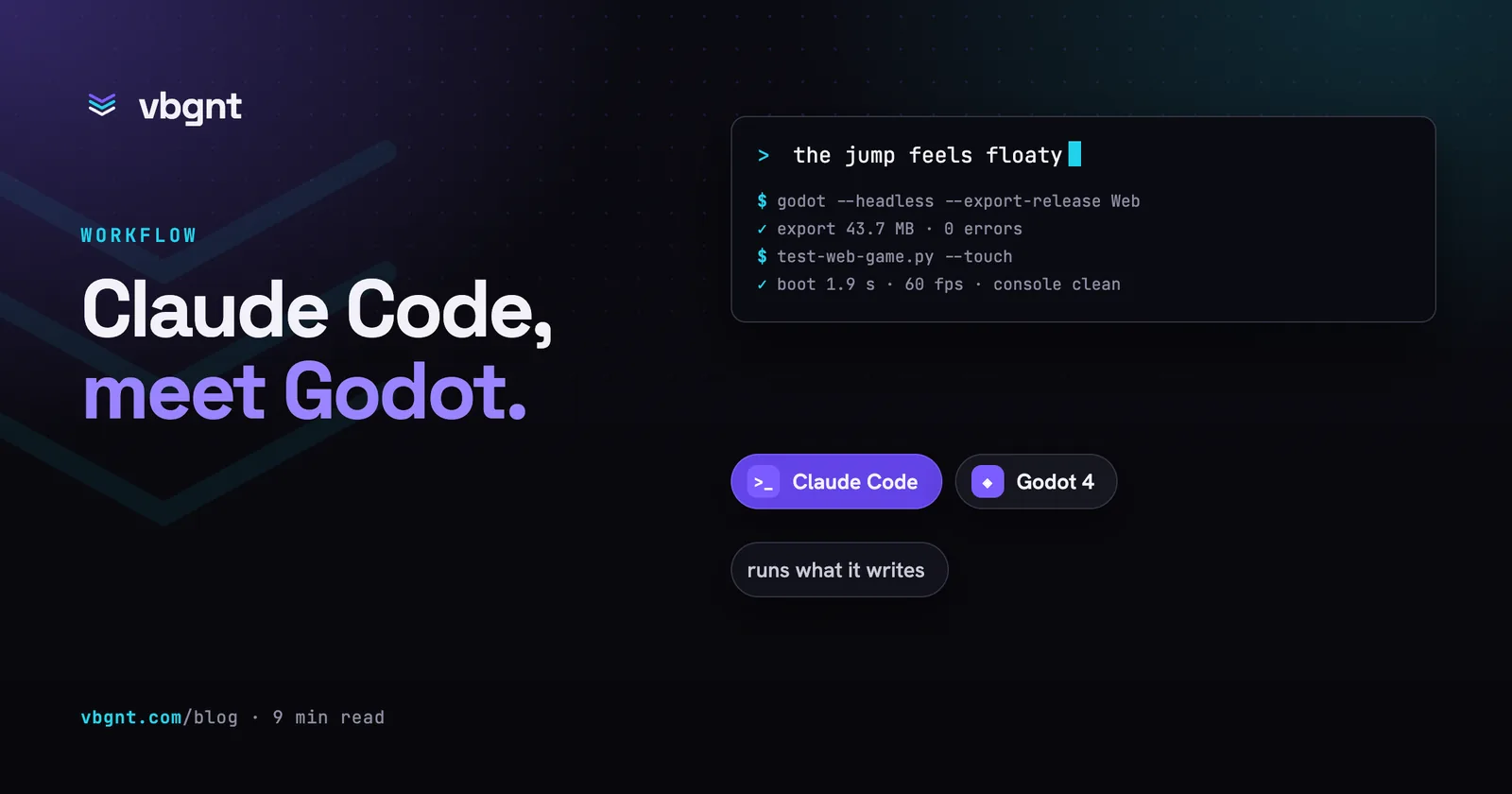
vbgnt is a studio: you describe a game, and an agent (Claude Code or GPT-6 Astra, your choice per message) writes a Godot 4 project, generates the art, music and sound, exports a web build, and plays it in a headless browser on desktop and phone emulation before handing it to you. Each game publishes to your own arcade at yourname.vbgnt.com, can be online multiplayer, and exports to Windows, macOS, Linux, Android and iOS; you can download the whole Godot project at any time. It is also an MCP server, so another agent can drive it.
The honest limits: builds take minutes rather than seconds, because a real engine is exporting and a browser is testing. And it is invite-only while we add capacity, with no public price list yet.
Is there a free AI game generator?
Yes. Astrocade is free outright. Rosebud, Star, Tesana, GDevelop and Replit all have free tiers, each limited in one of three ways: a cap on credits or generations, restrictions on commercial use, or no export. The third is the one worth checking first. Before you spend a weekend on a free tier, find the export button, and read whether the free plan lets you sell what you make: Tesana's free plan, for example, is non-commercial.
Is Rosebud AI free, and how much does it cost?
Rosebud is free to start: you can make and play games without paying. The free allowance is not published on its pricing page. Paid plans, as listed on 24 September 2026, are Indie Dev at $15 a month, 10x Dev at $30, Pro at $50 and Scale at $100, with credits that roll over once. Commercial rights begin at $30 and code download at $50. The paid plans currently show a promotional 10,000 bonus credits a day, which is a promotion rather than a daily limit.
What are the best Rosebud AI alternatives?
- Star, if you like Rosebud's browser-first approach but want hosted multiplayer and cheaper unbranded exports.
- Tesana or vbgnt, if you want a Godot project you can open, edit and take to a store rather than generated JavaScript.
- GDevelop, if you want to understand and edit the game logic yourself.
- Astrocade, if you mostly want to make small things quickly and have people play them, for free.
Which one should you use?
Decide what you want to own at the end. If the answer is "a link my friends can open", every tool here does that, and Rosebud or Star will get you there fastest. If it is "a game on Steam or the App Store", pick a tool that gives you an engine project and builds for those platforms: GDevelop, Tesana or vbgnt. If it is "the skill to make games", GDevelop. And if you only want to see whether you enjoy this at all, start with whichever free tier you can open right now.
Frequently asked questions
What is the best AI game generator?
It depends on what you want at the end. For a browser game you can share by link quickly, Rosebud or Star. For a real engine project you can edit and take to a store, a Godot-based tool such as Tesana or vbgnt, or GDevelop's AI agent. For free short games in a feed, Astrocade. For code to finish yourself, Replit.
Is there a free AI game generator?
Yes. Astrocade is free. Rosebud, Star, Tesana, GDevelop and Replit all have free tiers limited by credits, commercial use or export. Before building anything serious on a free tier, check that you can export the game and that the free plan allows you to sell it: Tesana's free plan, for example, is non-commercial.
Is Rosebud AI free?
Rosebud is free to start: you can make and play games without paying, though the free allowance is not published on its pricing page. Paid plans, as listed on 24 September 2026, cost $15, $30, $50 and $100 a month. Commercial rights and removing Rosebud branding start at $30, and downloadable project code at $50.
What are the best Rosebud AI alternatives?
Star for browser games with hosted multiplayer and unbranded exports; Tesana or vbgnt for a Godot project you can open and take to a store; GDevelop if you want to edit the game logic yourself in a no-code engine; and Astrocade for making and sharing short games for free.
Can an AI game generator make a game I can sell?
Yes, if its terms give you commercial rights and it lets you export the game. Check both before you start: some free tiers are non-commercial, some keep the game on the vendor's site, and some grant commercial rights only on higher plans. Stores like Steam accept AI-made games with disclosure.