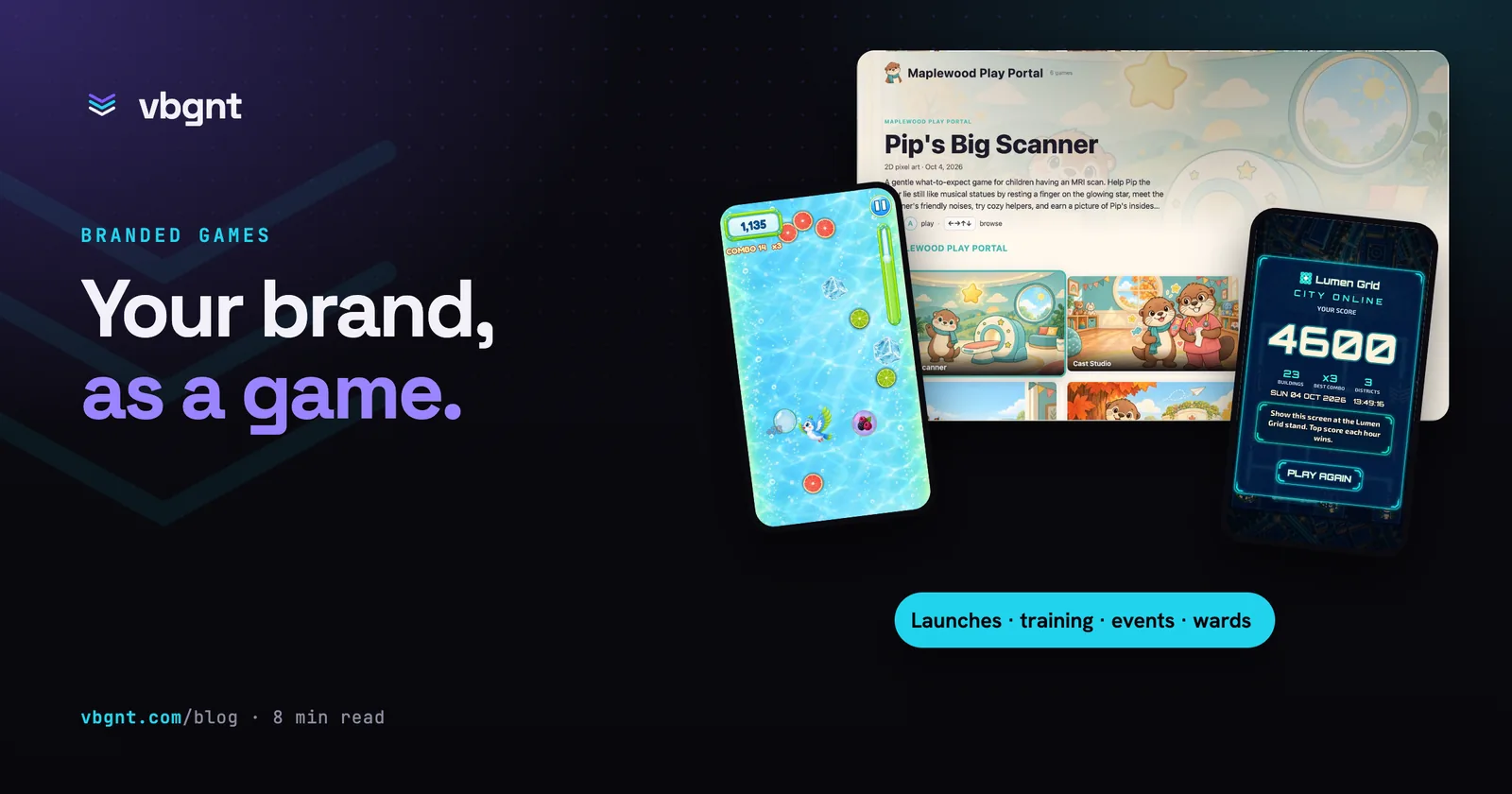
We now build games for other people. A brand launching a drink, a company that has to teach warehouse safety to every new starter, a stand at a trade show, a children's ward: each of them gets a short game built around them, played from a link, with nothing to install. The offer is on the branded games page.
Describing that in the abstract doesn't get far, so we wrote ten briefs for made-up clients and built every one of them in the studio: two product launches, a training course, a trade-show game and a portal of six games for a children's hospital. Every picture in this post opens that game's page, and you can play all ten in a browser right now.


What is a branded game?
A branded game is a short game built around a company's product, message or event, made to be played by its customers, staff or visitors. The older name is advergame. The point is usually attention: a few minutes with your product, your mascot or your safety rules, spent by choice rather than skimmed.
What made them hard to justify used to be the cost and the distribution. A bespoke game took a studio months, and then people had to install it. Ours run in the browser on phones, tablets, laptops and TVs, so a QR code on a stand or a link in a newsletter is the whole distribution plan, and a first playable version arrives in days. And for anyone who would rather install it, the same game ships as an iPhone app and an Android app.
What does a product launch game look like?
The first sample is for Fizzlark, an invented citrus sparkling water. You are a bubble rising through a tall glass: drag left and right to steer, collect lime and grapefruit slices, dodge ice cubes. Each flavour is a power-up (lime is a speed burst, grapefruit a shield, wild berry a magnet), so the product range is the game's rules rather than a banner beside them. A run lasts a minute or so, which is about how long anyone gives an advert on a phone.
The brand shows up where it would on the can. The lark mascot flies alongside on combos and cheers on the end screen, and the end screen carries the tagline, "Lighten up.", above a big Play again button. There are no links out of the game. That was a line in the brief, and it is a good default: a game that keeps sending people to a shop stops being a game.


The second launch is in 3D, for Trailhound, an invented hiking boot brand. You run a mountain trail from the trailhead to the summit over three short trails: forest, ridge and snowfield. The surface is the game. Wet rock, mud, loose scree, snow and log bridges each change your grip, and before each trail you pick one of three boots with grip, speed and stability bars. The product is literally the choice you make, and a hound guide waits at each checkpoint with a tip about the ground ahead ("Mud ahead. Mudlines love this.").


Can a game replace a training module?
It can replace the part people skim. Northgate Freight is an invented logistics company, and its game is the safety induction a new warehouse starter would otherwise click through as slides. One shift is five short modules: suit up with the right kit, walk to your station inside the green lanes and stop at crossings, spot the hazards in a busy aisle, choose the safe way to lift each load, and decide what to do about five problems on the floor.
Every answer, right or wrong, explains why in one sentence. That was the most useful line in the brief, because it is where the teaching happens; a quiz that only says "wrong" teaches the answer key. The shift ends with a certificate showing the player's first name, a score per module and the date, built to be screenshotted and shown to a trainer. The name is typed once and kept on the device.


To be clear about what it isn't: a game like this does not make anyone certified. It sits alongside the real induction and makes sure the five rules that matter most have been met once, by doing, before the first shift.
What works at a trade show stand?
Something people can finish while they queue for coffee. Lumen Grid is an invented cloud networking company, and its stand game is a 60-second puzzle played on visitors' own phones from a QR code. A night city sits dark below a glowing data centre; you tap tiles to rotate them and route the light to the buildings, and lighting several in one move builds a combo. When the minute is up, the whole city lights at once.
The end screen is designed for the stand rather than the player: a huge score, the date and the time, and the line "Show this screen at the Lumen Grid stand. Top score each hour wins." That makes the prize draw honest without a sign-up form. There is also an attract mode for a big landscape screen on the stand: after 20 seconds idle it plays itself, and any key or gamepad button starts a real round.


What did we build for the children's hospital?
The biggest sample is for Maplewood Children's Hospital, also made up: six small games for children aged 4 to 12, all starring the hospital's mascot, Pip the otter, in a teal scarf. Children's hospitals already use play to prepare children for procedures. Play specialists walk them through what a scan will sound like or what a cast is for, because a child who knows what is coming is calmer when it does. These games are a way to take some of that onto a ward tablet.
The six sit in one portal under the hospital's own name, logo and colours (soft teal on warm cream), with no vbgnt branding, no share or report buttons and no links out. Nobody signs in. On a laptop it reads like a console dashboard; on a phone the games fall into two columns.


The Maplewood Play Portal on a laptop and on a phone. Open the portal and play any of the six.
Every hospital brief repeated the same rules, so each game stands on its own: no ads, no chat, no accounts and no data collected; large touch targets, playable with one hand and lying down; calm music with a big mute button on every screen; no flashing, no jump scares and no timers that punish; and nothing fails hard, so a mistake just gets a gentle retry. Sessions are two to five minutes. The six games split into three that explain something and three that are just for the child.
Three that explain what's coming
Pip's Big Scanner is about having an MRI. It's musical statues: the child rests a finger on a glowing star to help Pip lie still for short rounds of 10 to 20 seconds, which is the hardest part of a real scan. Between rounds Pip meets the scanner's noises one at a time at a soft volume, each with a friendly name ("Knock knock! Like a woodpecker. That's normal."), and tries the things that help: music in headphones, a warm blanket, a grown-up nearby, slow breaths.


Cast Studio is about breaking a bone. Pip has a sore arm; the child slides the pieces of a clean, cartoon X-ray back together, then the doctor puts on a cast, which the child colours and decorates with stickers and doodles. Finished casts go into a small gallery on the device. Germ Busters turns handwashing into six steps (palms, backs, fingers, thumbs, tips, wrists) with googly-eyed germs floating away in bubbles and a sticker chart at the end.


Three that are just for the child
Bubble Breaths is a breathing exercise for before something that feels scary. Hold to breathe in and a bubble grows in Pip's paws; let go to breathe out and it floats up and becomes a fish, a starfish or a jellyfish, so the sea slowly fills with friends. It paces about four counts in and six out, follows the child if they go faster, and has no score and no way to lose.
Pip's Window Garden is for children staying a while. Plant seeds in Pip's window box and they grow a little in real time between visits, so there is something new each time; a ladybird, a bee, a robin and a snail turn up as it grows. Nothing ever wilts. Where's Pip? is a seek-and-find around a cartoon hospital (playroom, ward, X-ray room, pharmacy, café, rooftop garden), with one friendly line about each room, to make the building feel less strange.


None of this replaces a play specialist, and a real hospital would want its own clinicians to read every line before a child sees it. That review is part of the job, and it's quick to act on: a change of wording is a short note to the studio and a new build, not a new contract.
How were they made?
Each game started as a written brief of a few paragraphs: what the game is, how it plays, how long a session lasts, the brand's name, palette and mascot, and any rules (the hospital rules above, or "no links out of the game"). We gave the ten briefs to Claude Code connected to the studio through our MCP server, which created the games one at a time, waited for each first build, and put the six hospital games in a collection in portal mode with Pip as the logo. The ten were started back to back over one evening and into the night.
Then each one got a marketing kit, which is where every screenshot in this post comes from, and a published game page with a play button and its own privacy policy. A client gets the same: the game, its page, the numbers that matter for a campaign (page views, players, plays and time played), a portal if there is more than one game, and mobile apps for the App Store and Google Play.
A sample is not a client project. The real thing starts with a call, uses the client's own logo, characters and tone of voice, and goes through revision rounds agreed up front. But the samples are built the same way, in the same studio, from the same kind of brief, so they are a fair picture of what you would get.
Can it be an app too?
Yes, and you get one with every game. Each game is an ordinary Godot project, so the same game that plays from a link also builds as a native iPhone app and a native Android app. The studio produces the store screenshots, artwork and listing copy from the same marketing kit, and the apps go to the App Store and Google Play under whichever developer account the client prefers: their own, so the listing carries their name, or vbgnt's, so they don't have to set one up.
That is the same route our own games took: the first vbgnt games on the App Store and Google Play covers what it involves. The link still does the heavy lifting at a stand or in a newsletter, because nobody waits for a download in a queue. The app is for the people who want to keep playing: a trainee coming back to a module, a child going home after a stay on the ward, a fan of the drink.
How do I get one?
Tell us about it with the form on the branded games page; a few sentences is enough. We reply within two working days, agree what the game is and the deadline on a short call, and send a fixed quote before any work starts. A first playable build usually arrives within a week of the call.
Frequently asked questions
What is a branded game?
A short game built around a company's product, message or event, made to be played by its customers, staff or visitors. The older name is advergame. It is usually played in a few minutes from a link or a QR code, and the brand shows up in the rules, the characters and the end screen rather than as an advert beside the game.
Do players have to install anything?
No. The games run in the browser on phones, tablets, laptops and TVs, with touch, keyboard and gamepad controls. Players open a link or scan a QR code and the game starts. Nobody creates an account.
Can a branded game be a mobile app?
Yes, and every game comes with one. The same game ships as a native iPhone app and a native Android app, with store screenshots, artwork and listing copy, published to the App Store and Google Play under the client's own developer account or under vbgnt's.
Can several games sit together under our own name?
Yes. A portal puts several games in one place with your name, logo and colours, without vbgnt branding, share or report buttons, or links out. The hospital sample in this post is six games in one portal, made to work on a ward tablet.
Are the brands in these samples real?
No. Fizzlark, Trailhound, Northgate Freight, Lumen Grid and Maplewood Children's Hospital are all made up. The games are real and playable: every screenshot in the post links to the game's page.
Can a game be used for staff training?
Yes, for the parts people tend to skim: kit, routes, hazards, safe lifting, what to report. The warehouse sample explains every answer in one sentence and ends with a certificate showing the player's first name, a score per module and the date. It is meant to sit alongside a real induction, not to certify anyone.
How long does a branded game take?
Most take two to four weeks from the first call to launch. A first playable build usually arrives within a week of the call, and we send a fixed quote before any work starts.