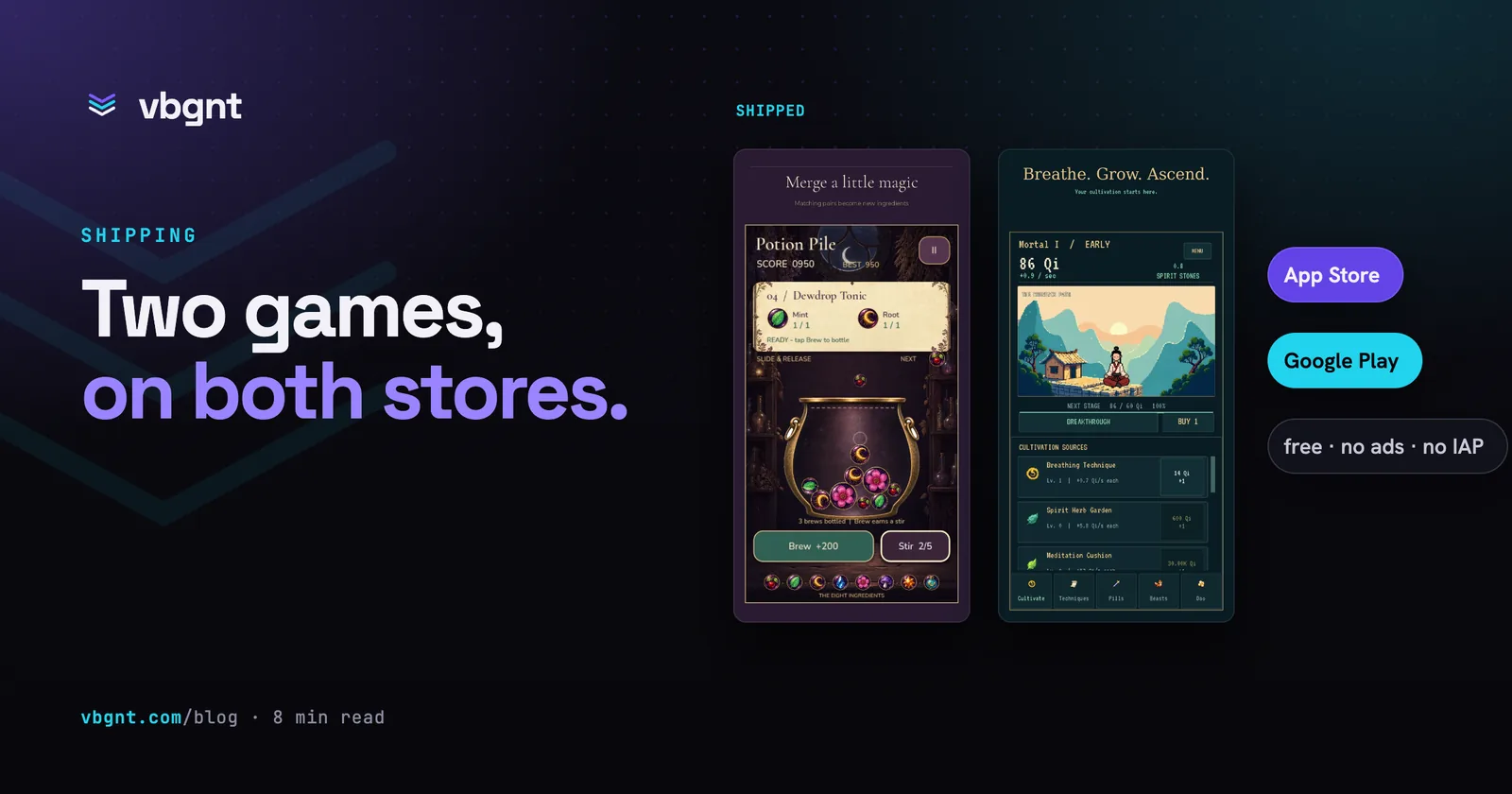
Two games made in the studio are on the App Store and Google Play. Potion Pile is a cozy physics merge puzzle set in a moonlit apothecary. Nine Heavens Ascent is a pixel-art idle game about breathing Qi on a mountain and breaking through one realm at a time. Both are free, both are single player, and neither carries ads or in-app purchases. They are the first vbgnt games to land as native apps on both mobile stores.
We have written before about exporting a game for desktop and mobile, about publishing to the App Store, and about the marketing kit that fills the store forms. This is the first time all of it ran end to end into something a stranger can install from a store search. Here is what the two games are, exactly which parts the studio produced, which parts a person still had to do, and the one thing the agent refused to fake along the way.
Potion Pile
Potion Pile is a merge puzzle that takes place inside a cauldron. You slide to aim and release to drop jewel-like ingredients, matching pieces tumble into each other and merge, and the merges climb eight tiers from a Berry up to the Moon Elixir. A recipe card at the top of the screen rotates between Dewdrop Tonic, Moonrise Tea and Starlight Cordial, asking for more demanding ingredients the longer the run goes. When the ingredients it wants are in the pot, you tap Brew, the recipe bottles for points, and the pile gets shorter.
The decision the game is really built around is the Stir. Every brew earns one, you can bank five, and spending one swirls the pile into new positions. It is the only escape valve, so the interesting question is not where to drop next but when to admit the pile is getting away from you. Keep the settled ingredients under the danger line and the run continues. It plays in portrait and landscape and saves a personal best.
It is on the App Store and on Google Play, with its own page at games.vbgnt.com/p/potion-pile.
Nine Heavens Ascent
Nine Heavens Ascent is an idle game in the xianxia tradition: a mortal on a mountain, cultivating toward immortality. You tap the sanctuary to gather Qi and buy into eight idle sources that keep gathering while the app is closed. Above you sit nine higher realms, each with nine stages, and moving up means accumulating enough Qi to break through to the next one.
At every realm boundary the heavens object. A lightning tribulation begins and you tap the falling bolts to deflect them before the trial runs out, which is the only moment the game asks for reflexes instead of patience. Underneath that there are five Techniques to study, pills to craft for a timed boost, and spirit beast hunts that run on their own and pay in Spirit Stones. Later the game opens up: Reincarnation starts a new life that keeps your Stones and Techniques and pays Dao Insight, which buys twelve permanent nodes on a Dao Tree plus a repeatable Samsara wheel. Reach the top and a True Immortal ending is waiting, with a count of the lives you lived and the breaths you took to get there.
It is on the App Store and on Google Play, with its own page at games.vbgnt.com/p/nine-heavens-ascent.
What the studio produced, and what a person did
The useful part of a launch like this is the division of labour, because it is the honest answer to what an agent-built game actually costs you in time. Nothing in the left column was hand-made, and nothing in the right column can be handed to an agent today.
| The studio | The person |
|---|---|
| The game itself, in Godot 4, from a written brief and a long tail of follow-up prompts | Writing the brief, playing each build, and deciding what to change next |
| Art, music and sound effects, generated and hand-tuned in place | Rejecting the ones that missed and asking again |
| A headless-browser playtest on every build, so a broken build never reaches the arcade | Playing the real thing on a real phone before shipping it |
| Screenshots at every size the two stores demand, icons, adaptive icons, the feature graphic | Choosing which screenshots lead the listing |
| Listing copy counted against each field's limit, title through keywords | Reading it, and changing the lines that sounded like software describing itself |
| A landscape trailer and a portrait App Store preview, rendered with the engine's own movie-maker mode | Deciding whether the cut was good enough to upload |
| A release-signed Android App Bundle, and a zipped Xcode project for iOS | The Apple and Google developer accounts, the archive on a Mac, and the upload |
| Nothing | Age rating, data safety and App Privacy, export compliance, a support page, a privacy policy |
That last row is the one worth staring at. The questionnaires are not hard and they are not long, but they are legal statements about your app made in your name, and there is no version of this where a model signs them for you. Budget an afternoon for the paperwork on the first app and far less on the second.
The Mac is still the wall
Android went the way the Play guide describes. The Publish pane produced a release-signed .aab on a build machine that already has the SDK, the JDK and Gradle, so nothing had to be installed locally, and the upload key came out of the studio ready to download and keep.
iOS is the platform where the pipeline stops short on purpose. The pane exports a zipped Xcode project with the bundle identifier and Team ID already filled in, and that is as far as a Linux build machine can go: only Xcode on a Mac can sign and archive an iOS build, and Apple accepts builds made with a current Xcode and SDK. So the last mile for both games was a Mac, an archive, and an upload to App Store Connect. We would like to remove that step. We cannot, and neither can anyone else without a Mac in the loop.
What this proves and what it doesn't
It proves the path exists: a sentence becomes a playable build, the build becomes a store kit, the kit becomes a listing, and the listing becomes an app on two stores. Nobody wrote a line of the games' code or drew a frame of their art by hand.
It also settles a question we could not answer a month ago, which is whether anybody stays. Nine Heavens Ascent went up as a web build on itch.io before either app existed, and it has been played 1,236 times for more than 500 hours, with nearly all of that landing in the first four days. For an idle game that is the only number worth watching. Nobody accumulates 500 hours out of politeness, and an incremental loop whose numbers feel wrong gets closed inside ninety seconds. Those figures come from our own arcade analytics, counted the same way for every game on the platform.
What it does not prove is the rest of a game business. Both games are free with no ads and no in-app purchases, so 500 hours is attention rather than revenue. One breakout in a genre built for long sessions is a sample of one, and Potion Pile has had nothing like the same run. Store review is still a human process on someone else's schedule, an app still needs a support address a real person reads, and the studio still cannot want the game for you. What changed is that "will anyone actually play it" now has a number attached instead of a shrug.
Play them
Potion Pile: App Store · Google Play. Nine Heavens Ascent: App Store · Google Play. Both are published by A Walking City Games, and both were made in the studio by one person who is not an artist and did not write their code.
If you want to take your own game the same distance, the marketing kit makes the listing, the Publish pane makes the builds, and the store guides for iOS and Google Play cover the forms waiting at the other end.
Frequently asked questions
Which vbgnt games are on the App Store and Google Play?
Potion Pile, a cozy physics merge puzzle set in a moonlit apothecary, and Nine Heavens Ascent, a pixel-art idle cultivation game about breathing Qi and breaking through realms. Both are free, both are single player, and neither has ads or in-app purchases. They are published by A Walking City Games.
Did a person write any of the games' code?
No. Both games were built in the studio from a written brief and a long run of follow-up prompts, including the Godot code, the art, the music and the sound effects. The person in the loop wrote the briefs, played each build, decided what to change next, and handled the store paperwork.
Do you need a Mac to publish a vbgnt game to the App Store?
Yes. The Publish pane exports a zipped Xcode project with the bundle identifier and Team ID filled in, but only Xcode on a Mac can sign and archive an iOS build, and App Store Connect requires a build made with a current Xcode and SDK. A Linux build machine cannot do that step for you. Google Play is different: the pane exports a release-signed Android App Bundle you can upload directly.
Does vbgnt submit your game to the stores for you?
No. The studio produces the builds, the screenshots, the artwork and the listing copy, but the developer accounts, the upload and the compliance answers are yours. Age rating, data safety, App Privacy and export compliance are legal statements about your app made in your name, and no agent can sign them for you.
Do people actually play games built by an AI agent?
Nine Heavens Ascent, built entirely in the vbgnt studio, has been played 1,236 times for more than 500 hours as a web build on itch.io, with nearly all of that in its first four days. It is free, with no ads and no in-app purchases, so that figure is attention rather than revenue, and it is one game rather than a pattern. The play counts come from vbgnt's own arcade analytics.
How long does it take to get an agent-built game onto both stores?
The build and the store kit are a matter of hours of studio time rather than weeks. The paperwork is the slow half on a first app: developer account setup, the questionnaires, a support page and a privacy policy, plus store review, which runs on the stores' schedule and not yours.