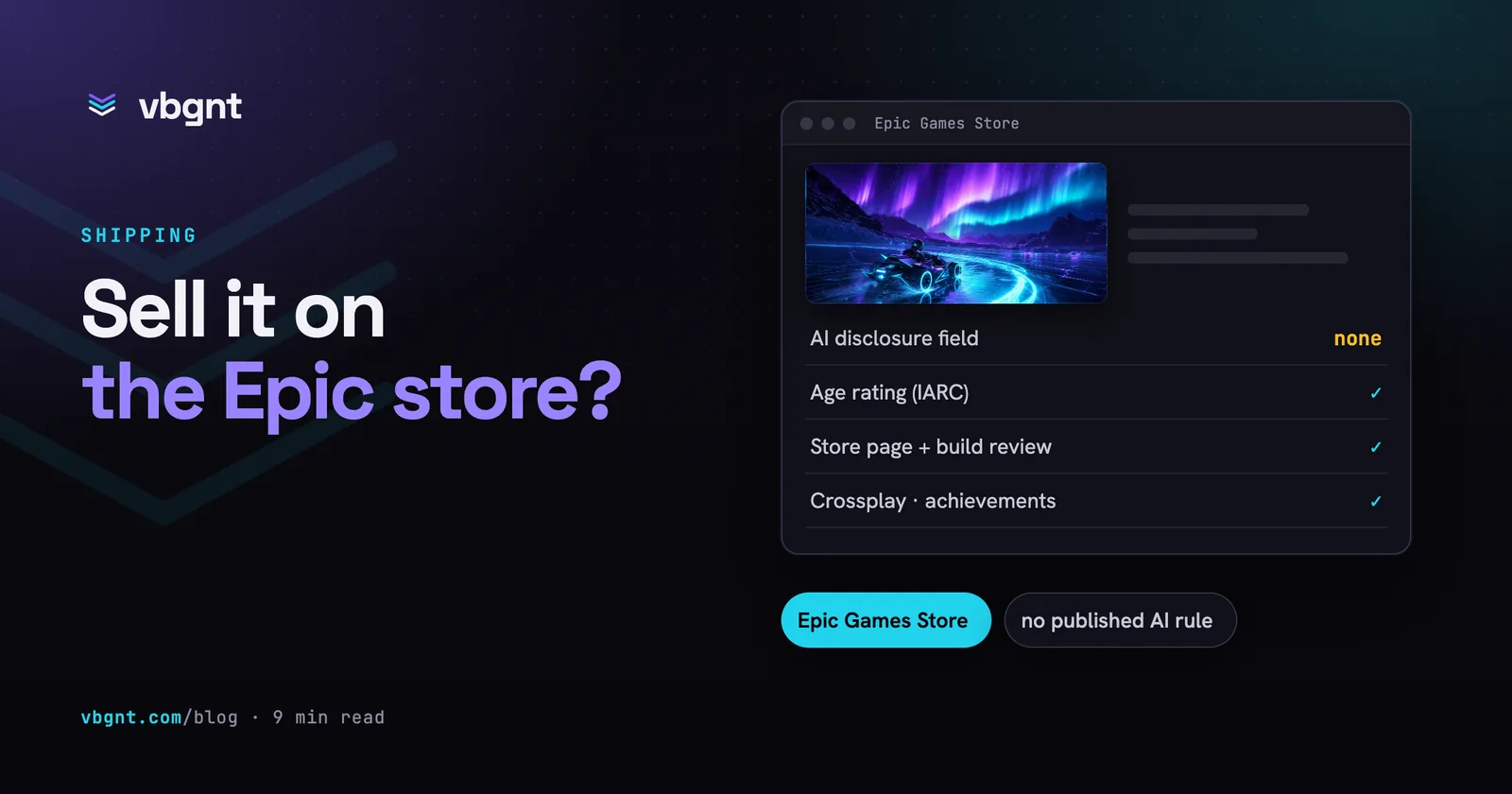
Yes. The Epic Games Store accepts games from any engine through its self-publishing tools, and a game made with AI goes through the same process as any other: an organisation in the Epic Developer Portal, a product, a store page, a build, a review. Unlike Steam, Epic's store pages show no AI disclosure label and no AI section.
That is the short answer. The longer one is mostly about what Epic has not done, what its chief executive has said instead, and the rules that apply to your game whether or not AI touched it.
Does the Epic Games Store require AI disclosure?
Epic has not published an AI disclosure requirement as of October 2026. We found none in Epic's public material on self-publishing or in its coverage, and its store pages carry no AI label for players to read.
Two caveats, stated plainly. First, the absence of a published rule is not a promise that there will never be one. Second, the documents that bind you are the ones you accept when you sign up, not this post. Before you submit, read the current Epic Games Store distribution agreement and content guidelines in the Developer Portal, and if either has grown an AI clause since we wrote this, it wins.
What has Epic said about AI labels?
The clearest statement comes from Tim Sweeney, Epic's chief executive, not from a policy document. In November 2025, as reported by PC Gamer and VGC, he said AI tags make sense for art exhibits and for content licensing marketplaces, but "make no sense" for game stores, because "AI will be involved in nearly all future production".
More recently, GamesRadar reported him describing Valve's disclosure mandate as "forcing developers to write a political statement to be used against them by the hate mob".
Read those for what they are: a chief executive's public remarks. They tell you which way Epic leans, and they are consistent with a store that has no disclosure field. They are not store policy, and they do not exempt you from anything you agreed to in the portal.
How is that different from Steam?
Steam is the store that wrote the rule, and the contrast is sharp.
| Steam | Epic Games Store | |
|---|---|---|
| AI disclosure | Required since January 2024, in the Content Survey. | No published requirement as of October 2026. |
| Shown to players | A summary appears on the public store page. | No AI label or section on store pages. |
| Code written with AI | Exempt since the January 2026 revision, which set aside coding tools. | Nothing to disclose, because nothing is asked. |
| Where the rule lives | Steamworks documentation. | Check the distribution agreement and content guidelines. |
Our post on selling an AI-generated game on Steam covers the Content Survey in detail: what counts as pre-generated and live-generated content, what the code exemption covers, and what happens if you do not disclose.
Does it matter how much of the game AI made?
Not to Epic's published rules, which do not draw the lines Steam draws. The code, the art, the music and the store page can all have come from AI tools, and there is no form on which you sort them into categories.
It still matters to you, for two reasons. The first is content generated while the game runs: a model writing dialogue or images on the player's machine produces things nobody reviewed, and the content guidelines and your age rating cover what the game shows, whoever or whatever made it. If you cannot say what the game might show, you cannot answer the rating questionnaire honestly. The second is that the same game on Steam is sorted into exactly those categories, and the two stores' pages are one search apart.
A vbgnt game sits in the easy case. The agent writes the code and generates the art and audio during production, a person plays the builds, and the shipped game is an ordinary Godot project. Unless you asked for a model inside the game, there is none, and everything a player sees was in the build Epic reviewed.
What still applies to an AI-made game on Epic?
Everything that applies to any other game. None of it mentions AI, and all of it decides whether you get on the store:
- You need the rights to everything you ship. No other game's characters, art, music or trademarks, generated or not, and a tool whose terms give you commercial rights to its output. See generative games and intellectual property.
- Epic reviews the store page and the build. The game has to launch, run, and be what its page says it is.
- An age rating through the IARC questionnaire in the portal.
- Crossplay for multiplayer games with players who bought on other PC stores.
- Achievement parity: if the game has achievements on another PC store, it needs them on Epic too.
The review is where a thin game gets caught, AI or not. A page promising features the build does not have fails on its own terms.
Should you tell players anyway?
That is a separate choice from any store rule. Epic not asking does not mean players will not find out, and a game sold on both stores already carries a Steam disclosure anyone can read.
If you sell on Steam too, keep the facts the same everywhere. The stores ask different questions; your answers should not contradict each other. How players react to a disclosure, and why a specific one goes down better than a vague one, is covered in the Steam post, and none of it changes because the store is different.
Getting a vbgnt game onto Epic
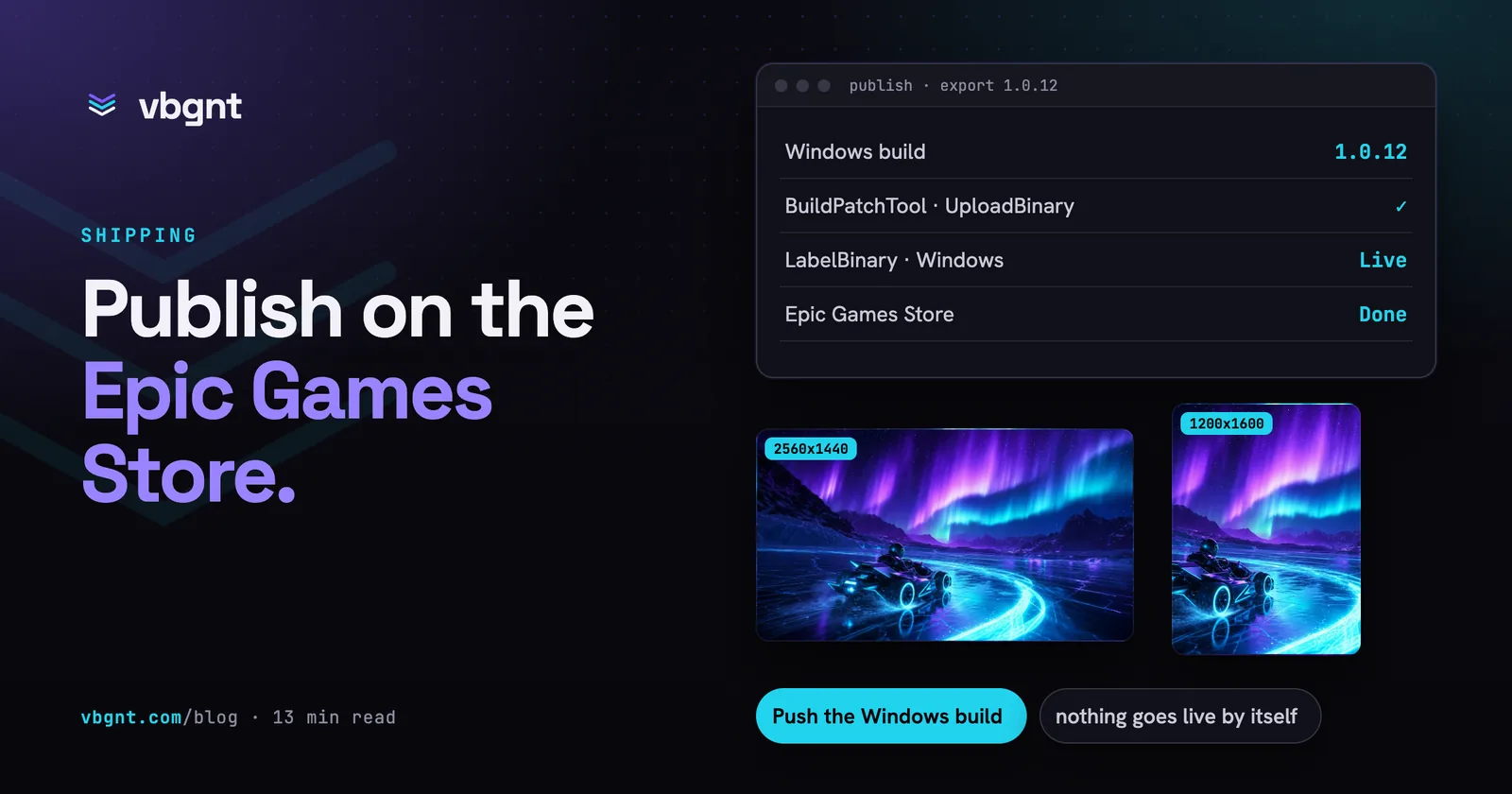
A vbgnt game is a Godot 4 project, and Epic takes its Windows build. In the studio's Publish pane, tick Windows and Push the Windows build to the Epic Games Store, enter the ids from the Developer Portal, and the export uploads the build with Epic's BuildPatchTool and labels it. Under Marketing kit, the Epic Games Store option makes the 2560x1440 and 1200x1600 offer images, the transparent logo, 1920x1080 screenshots and the store text from the game's real captures.
The organisation, the $100 fee, the rating questionnaire and the review stay with you. Our guide to publishing a Godot game on the Epic Games Store goes through every step.
Frequently asked questions
Does the Epic Games Store allow AI-generated games?
Yes. The Epic Games Store accepts games from any engine through its self-publishing tools, and a game made with AI goes through the same process as any other: an organisation in the Epic Developer Portal, a product, a store page, a build and a review. Its store pages show no AI disclosure label.
Do you have to disclose AI use on the Epic Games Store?
Epic has not published an AI disclosure requirement as of October 2026, and there is no AI section on its store pages. Read the current Epic Games Store distribution agreement and content guidelines in the Developer Portal before you submit, because those documents, not a blog post, are what you agree to.
What has Tim Sweeney said about AI labels on game stores?
In November 2025, as reported by PC Gamer and VGC, Epic's CEO said AI tags make sense for art exhibits and content licensing marketplaces but "make no sense" for game stores, because "AI will be involved in nearly all future production". GamesRadar later reported him calling Valve's mandate a requirement "forcing developers to write a political statement to be used against them by the hate mob". These are public remarks, not Epic store policy.
How is Epic different from Steam on AI?
Steam has required AI disclosure in its Content Survey since January 2024 and shows a summary on the store page; the January 2026 revision exempted coding tools. Epic has no published equivalent. If you sell on both, you fill in Steam's survey anyway, so keep your description of what was generated consistent across both pages.