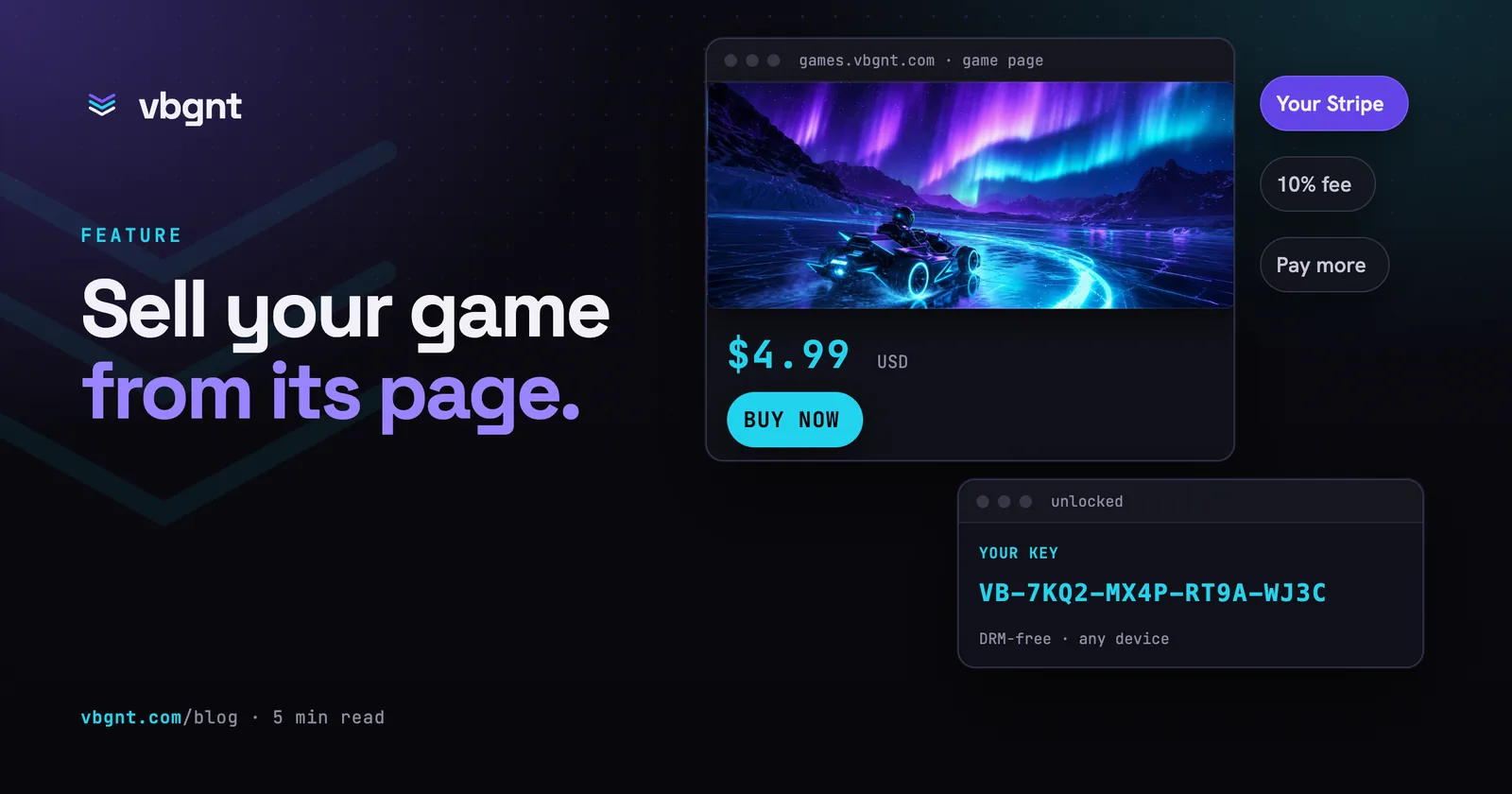
You can now sell a game you made in vbgnt. Put a price on it in the studio and its page on games.vbgnt.com gets a Buy button. A buyer pays on Stripe's checkout, comes back to the page with the game unlocked (in the browser, and as downloads if it has any), and gets a key by email that unlocks it again on any device. The money goes to your own Stripe account. We keep 10%.
Here is how it works, what you get and what you don't, and the parts we haven't built yet.
How do you sell a game made with vbgnt?
Three steps, all in the game's new Sales pane in the studio:
- Connect Stripe. Pick the country you sell from and press Connect Stripe. Stripe's own pages ask for your details and a bank account. It takes a few minutes, and Stripe sometimes checks a detail or two before it switches payments on. The Sales pane says what it is still waiting for.
- Set a price. Anything from $1 to $200. Turn on Pay what you want and buyers can choose to pay more than that, never less.
- Turn it on sale. The game's page is published again on the spot, with the Buy button at the top. Play in your browser and the downloads are locked until a buyer's key opens them.
The game needs a published page, because that is where buyers pay. A game that only plays in the browser can be sold as it is. If it has downloads (Windows, macOS, Linux or Android), the buyer gets those too. Would rather keep the browser version free, as a demo? Turn on Free to play in the browser and only the downloads are sold.
Agents can do the same over MCP. connect_stripe hands back
the Stripe link for you to open (the agent never fills in Stripe's forms),
set_sale sets the price and get_sales reads the
numbers back.
Who is the seller, and what does it cost?
You are. Every sale is made on your own Stripe account, so the buyer's receipt carries your name, the payout goes to your bank, and refunds and disputes are yours to handle from your Stripe Dashboard. vbgnt never sees a buyer's card.
We take 10% of each sale, the same cut itch.io takes by default. Stripe's processing fee comes out of your share too, as it would on any Stripe payment. On a $5.00 game, we keep 50 cents and you get the rest less Stripe's fee.
Because you are the seller, sales tax and VAT are yours as well. We don't calculate or collect it for you yet. If you sell to places that tax digital goods, look at what you owe there before you turn a sale on.
What does the buyer get?
The game, for good. After paying they land back on the game's page with a short note that they own it, their key, Play in your browser working and every download card unlocked. The same key arrives by email, with a link that opens the page already unlocked. It works on any device and keeps working when you put up a new version.
Owning the game also opens it on the developer's arcade and in the games
directory, in the same browser. Keys look like VB-ABCD-EFGH-JKLM-NPQR. A
buyer who loses the email can type the key into the page instead. The page
remembers it in that browser, so coming back next month just works.
From the Sales pane you can see each purchase (email, amount, date, how many times the key was used) and do three things with it:
- Resend the key to the buyer.
- New key: the old key stops working and the buyer gets the new one. This is for a key someone posted publicly.
- Revoke the purchase, or restore it.
A refund or a dispute on Stripe revokes the purchase by itself, so a key stops working as soon as its money goes back.
Does a key stop piracy?
No, and nothing does. The downloads are ordinary DRM-free files. Once someone has the zip, it is theirs to copy, the same as on itch.io. What a key controls is who can fetch the game from vbgnt. A page on sale never publishes the downloads at a public address, and every visit asks for fresh links that expire in 15 minutes.
The browser version works the same way. While it is sold, every file of the web build needs a pass, and only a key hands one out. A pass lasts two days and renews each time the buyer comes back, so a pasted link shows the Buy button instead of the game, and a refunded key stops playing within two days. A key that gets passed around can be replaced without bothering the person who paid. Someone who has bought the game can still save its files from their browser, which is why we call this a lock on the door, not a safe.
We think that is the right trade. Heavy copy protection mostly punishes the people who paid, and the players most likely to buy a small game are the ones who like the person who made it.
What doesn't it do yet?
- The phone apps leave paid games out. Apple and Google require their own billing for games bought inside an app, so the vbgnt launcher apps only list games that are free to play. Buyers play on the web, on any phone's browser.
- itch.io gets the downloads only. Pushing a game's web build to itch.io would put the browser version up for free, so while it is sold here the Publish pane won't send it there.
- Prices are in US dollars. Buyers elsewhere pay in dollars and their card does the conversion.
- Unpublishing the page locks buyers out. Their keys unlock the game on its page, so keep the page up while you have buyers.
- Online features don't check the key. We want multiplayer rooms, cloud hosts and high scores to be able to ask for a valid key in paid games, so a shared copy plays alone. That isn't built yet.
How is this different from selling on itch.io or Steam?
It isn't a replacement for either. Steam and itch.io bring buyers who are already shopping. The Publish pane still pushes your builds to itch.io and the Epic Games Store, and the marketing kit still makes Steam store art. Selling from your own page is for the people you send there yourself: the ones who found you through a video, a post, your arcade or a friend. Until now they could play your game but had no way to pay you for it. Now you can decide whether they should.
Frequently asked questions
How do I sell a game I made with AI on vbgnt?
Open the game's Sales pane in the studio, connect a Stripe account, set a price and turn the sale on. The game needs a published page. The page is published again straight away with a Buy button, and its browser version and any downloads (Windows, macOS, Linux or Android) stay locked until a buyer's key unlocks them.
How much does vbgnt take from each sale?
10% of the price, taken as a fee on each payment. Stripe's own processing fee also comes out of the seller's share. Everything else is paid out to the seller's bank account by Stripe.
Do I need my own Stripe account to sell games on vbgnt?
Yes. Connecting Stripe in the Sales pane creates one if you don't have one, on Stripe's own sign-up pages. Every sale is made on that account, so you are the seller, you see every payment on your Stripe Dashboard and you handle refunds there.
What does a buyer get when they buy a vbgnt game?
The game in the browser, its downloads (DRM-free) if it has any, and a key by email (it looks like VB-ABCD-EFGH-JKLM-NPQR). The email's link opens the game's page unlocked on any device, and the key keeps working when the developer puts up a new version.
Can buyers share their key?
They can try. Each download link expires in 15 minutes, browser play needs a pass that lasts two days and only a valid key renews, every key use is counted in the Sales pane, and the developer can replace a key that has been posted publicly without affecting anyone else. A refund or a dispute stops the key automatically. Once downloaded, a game is an ordinary file, as on itch.io.
Can I sell a game that only plays in the browser?
Yes. While a game is on sale its web build only loads for people who own it: on its page, on the developer's arcade and in the games directory. Anyone else sees the Buy button. If you would rather sell only the downloads, turn on Free to play in the browser and the web version stays open as a demo.