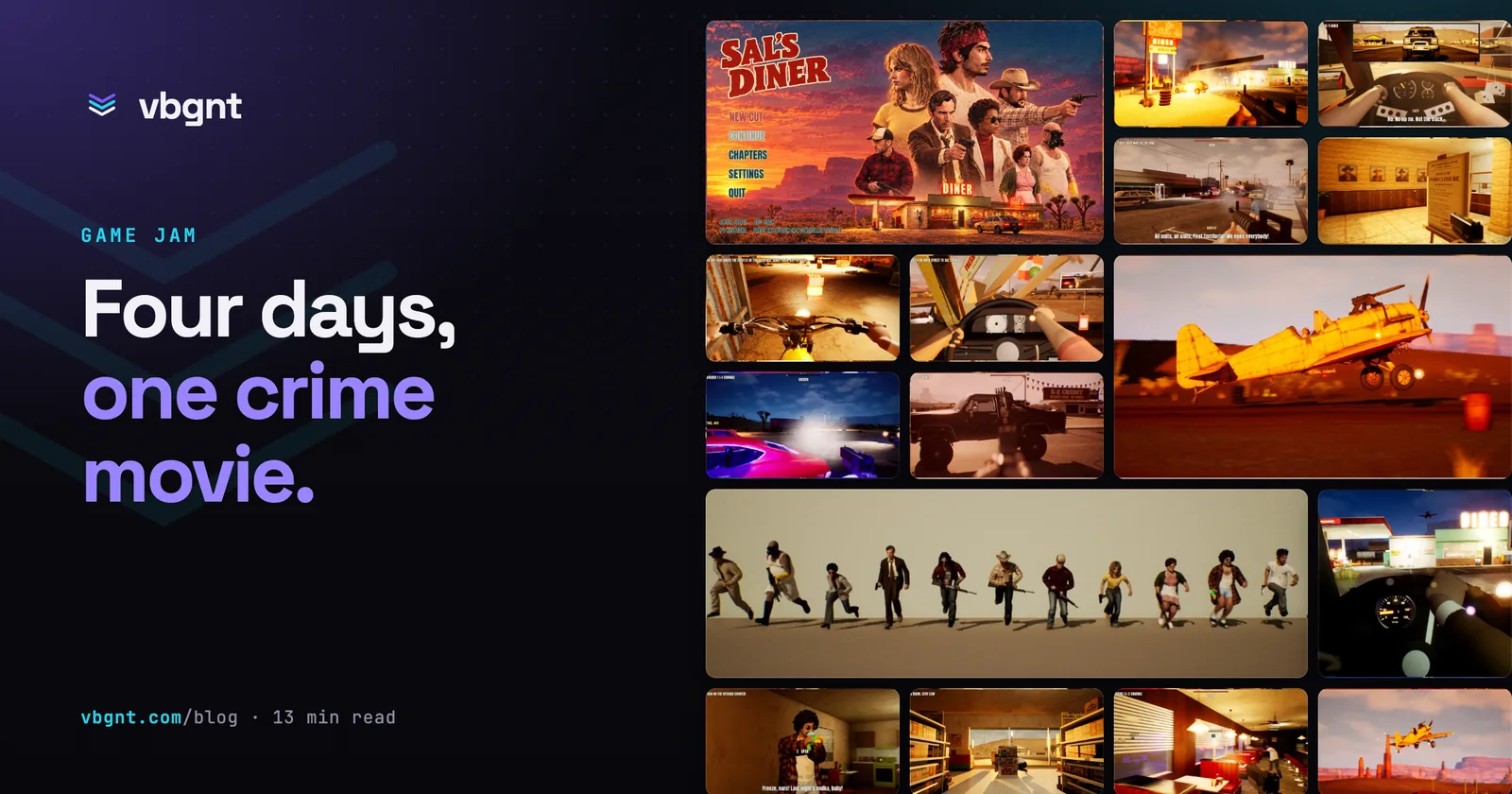
Last week I entered the 2026 Epic AI MegaJam. The theme was "Director's Cut", the clock was four days, and the entry had to be an Unreal Engine game under 1 GB. I made Sal's Diner: a first-person crime movie in five chapters, with five leads, a town, eleven voiced characters, cars with working mirrors, a dirt bike and a plane that strafes the highway.
I never opened the Unreal editor. The game was built by agents in the vbgnt studio, on Unreal 5.9, driven turn by turn from an assistant over MCP. This post is how the four days went: the plan, what each day produced, what broke, and what I'd do again. Each day also has a video diary, embedded below.
Play it: Sal's Diner is on itch.io at vbgnt.itch.io/sals-diner, for Windows and Mac.
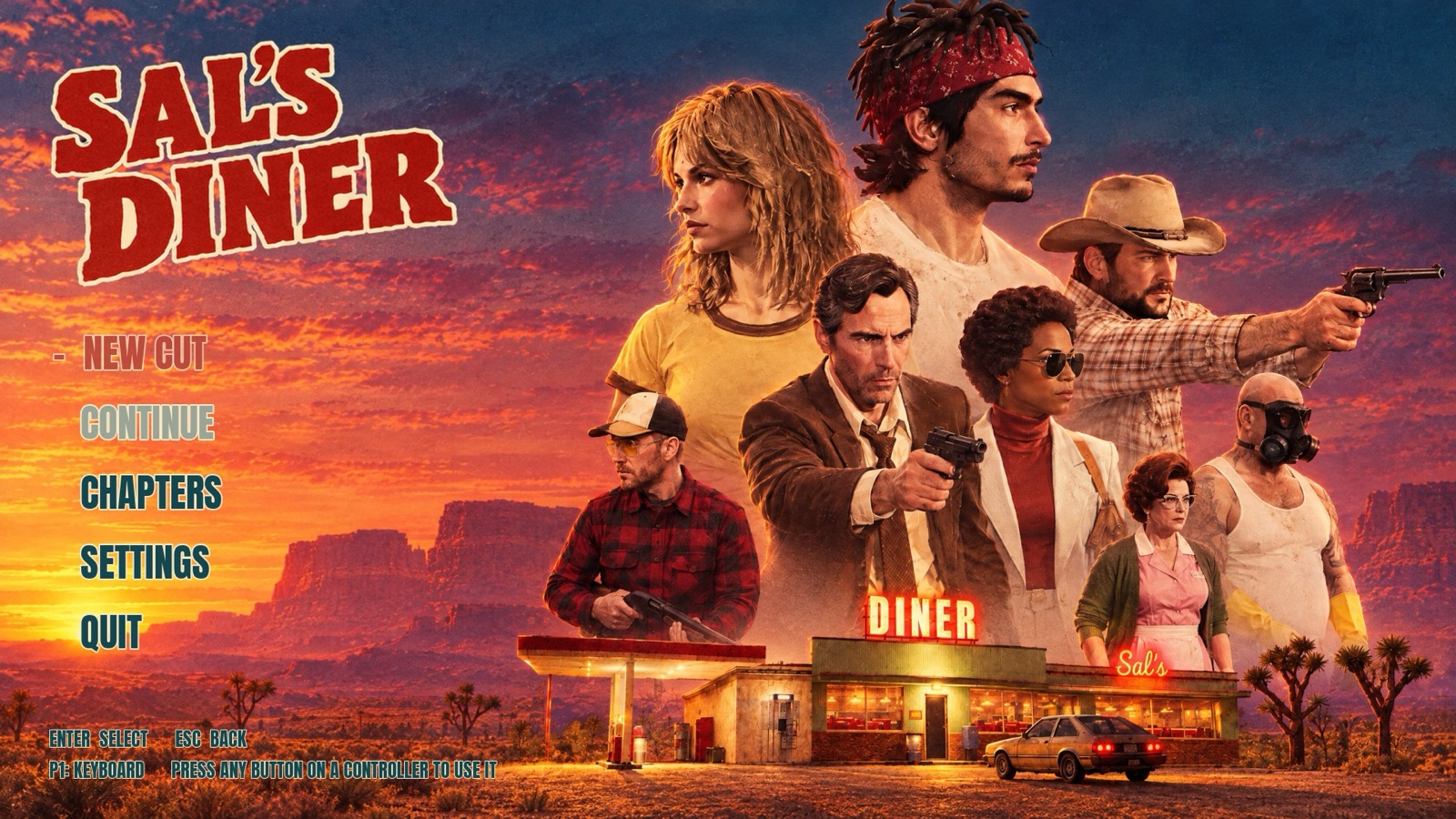
What is Sal's Diner?
I took the theme literally. The game is a movie, and the player re-cuts it. Mercy, Arizona, population 1,204, on a Friday afternoon:
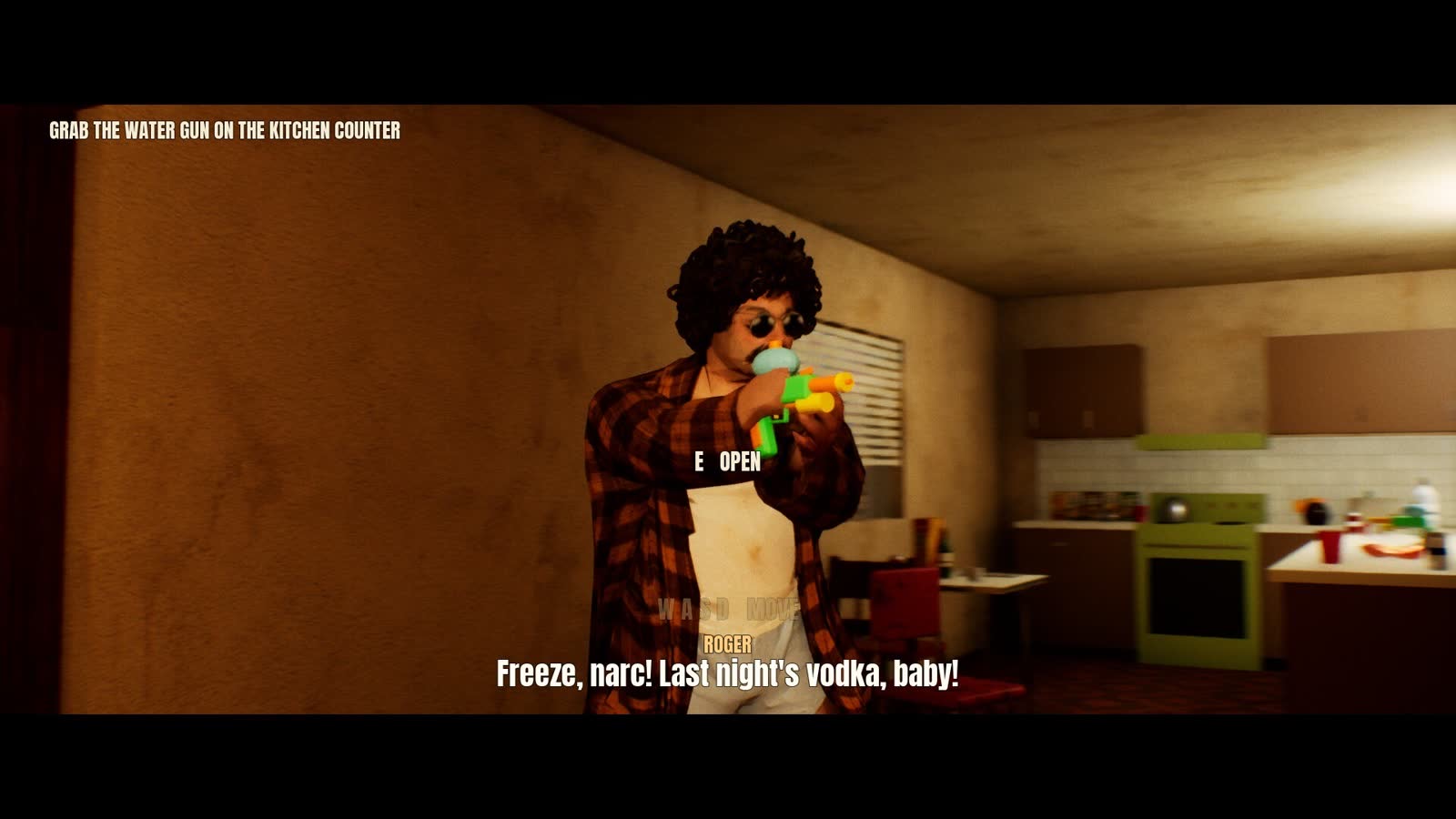
- Chapter 1, "Late Again". Diego, a hung-over line cook, is late for his shift. His roommate ambushes him with a water gun. This is the tutorial.
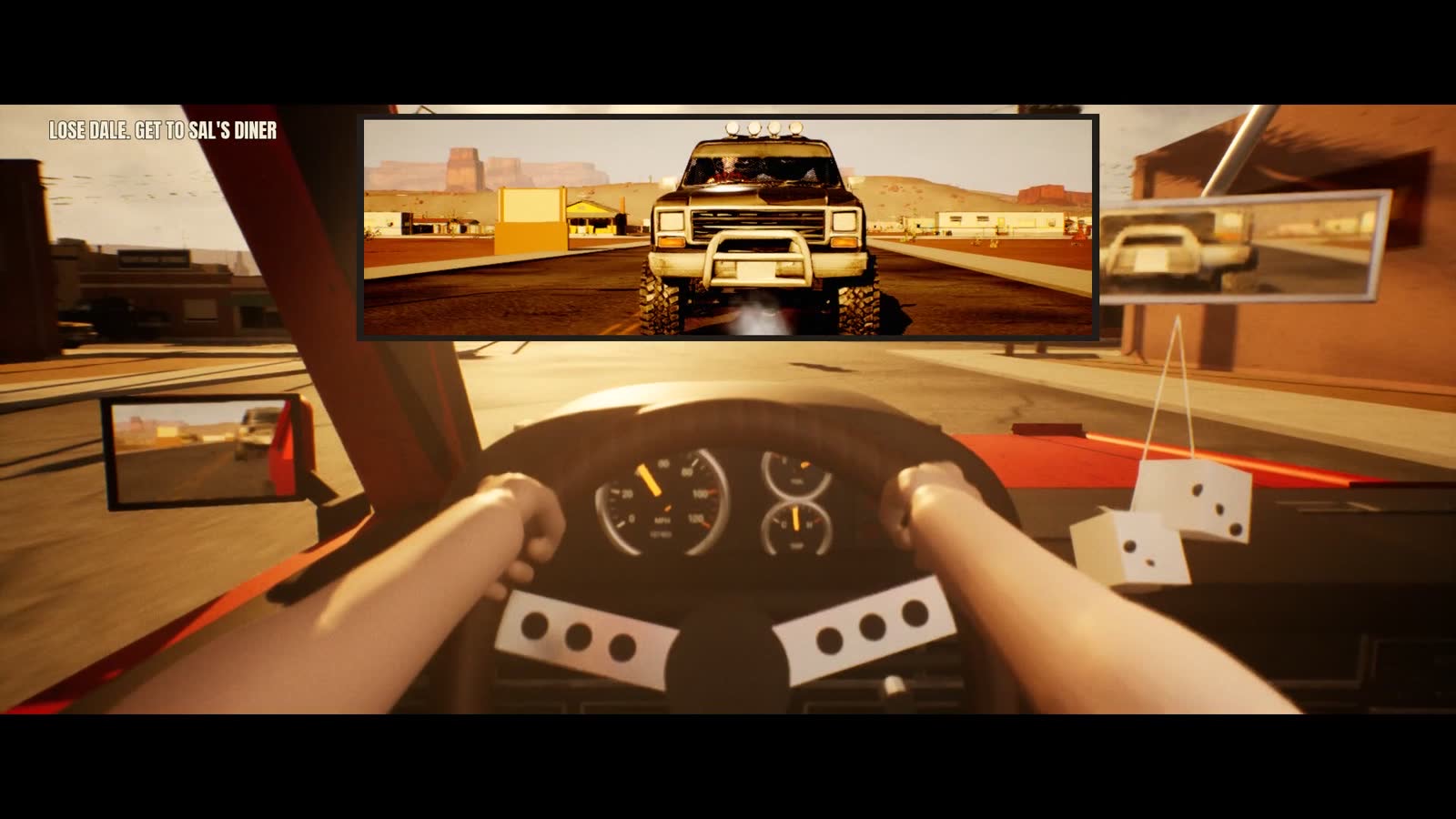
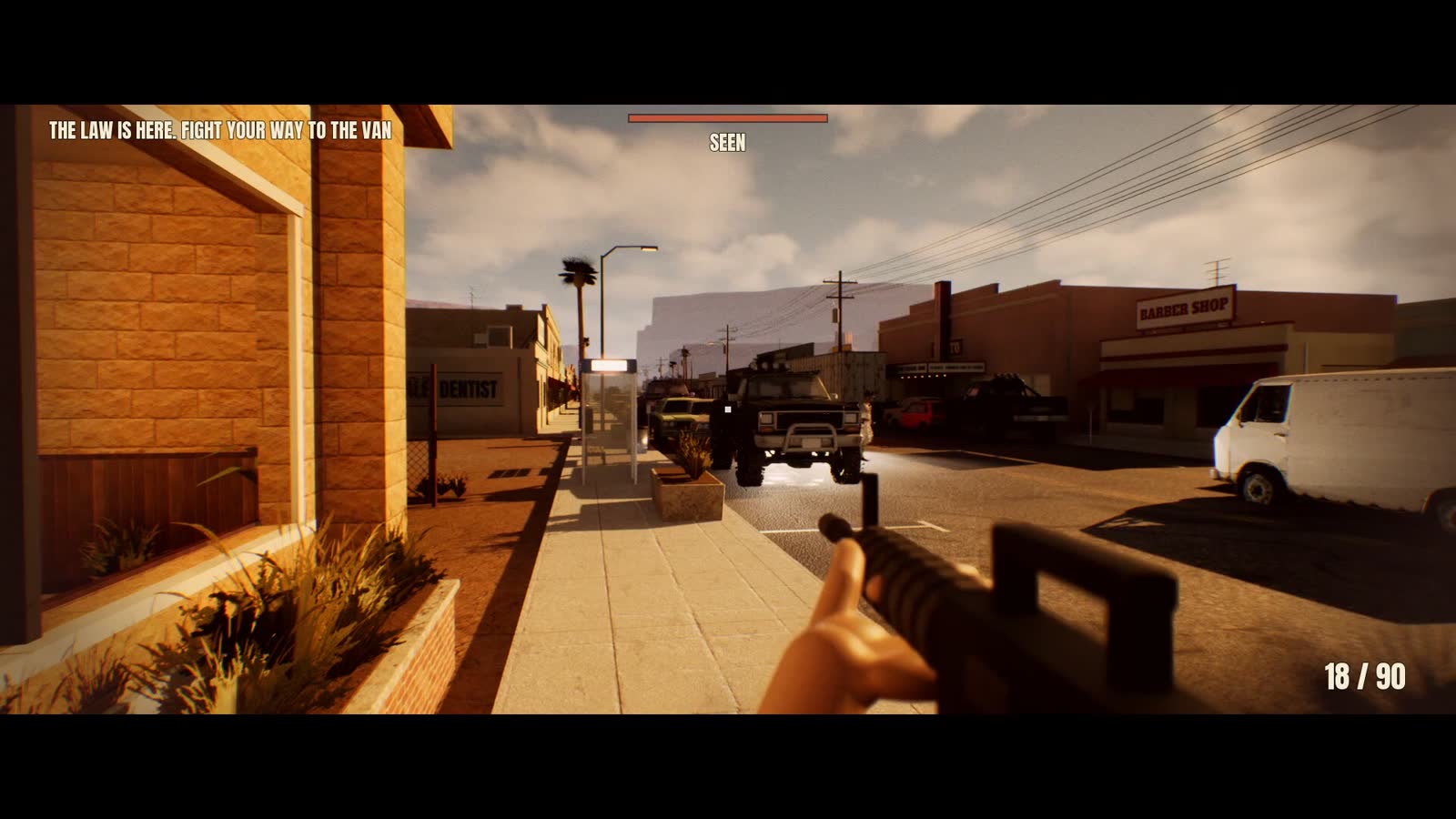
- Chapter 2, "Aisle Five". Lucy hides in a supermarket from Dale, a patient, polite man with a shotgun, then runs for it with his pickup in her mirror.
- Chapter 3, "Foreclosure". Johnny and Rick Tull rob the bank that took their farm, and fight the sheriff's deputies in the street.
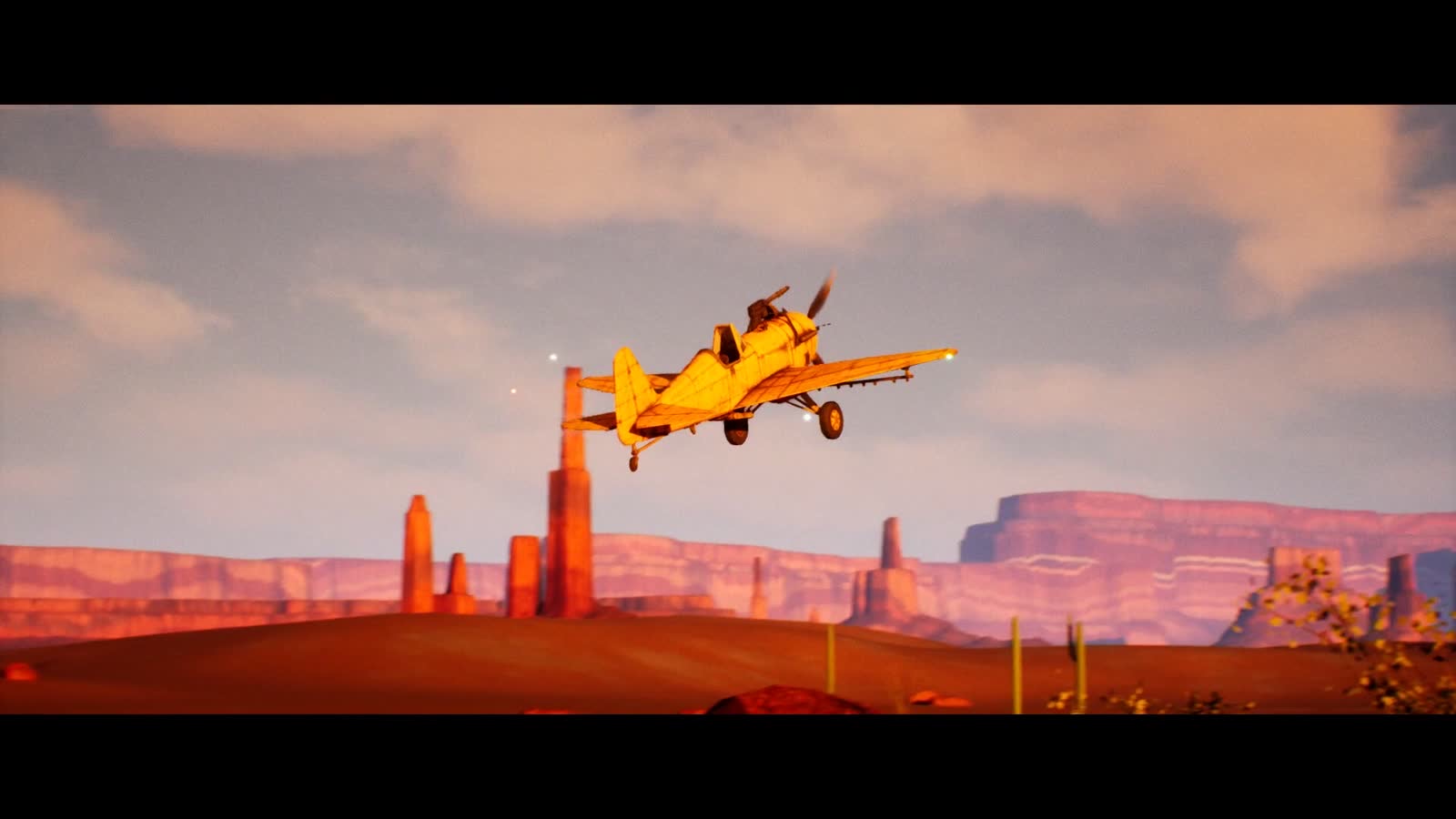
- Chapter 4, "Pie Before You Go". Two crooked detectives, Rusty and Nicole, rob a drug lab in the desert. Its owner has an M60 and a plane.
- Chapter 5, "The Showdown". Every chapter ends when its lead pushes open the door of Sal's Diner. That night, everyone who made it is inside when their pursuers pull up.
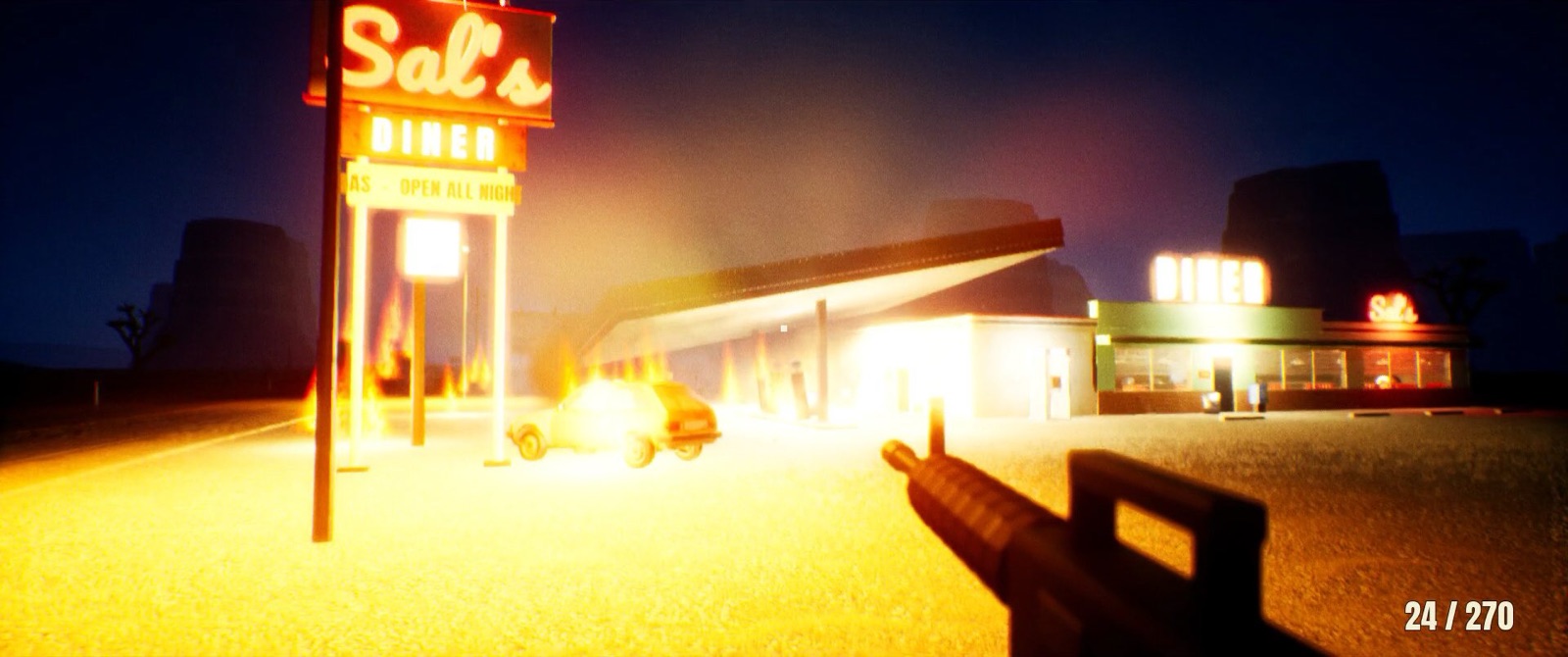
What you do in one chapter carries into the next. Run Dale over in chapter 1 and he limps in chapter 2. Kill a lead and their chapter is gone. Shoot the pumps at Sal's Gas and the Showdown is fought in the ashes.
How do you plan a game for four days?
One day per job: the base game on day 1, every chapter built at the same time on day 2, play-testing and polish on day 3, packaging and the store page on day 4. The only way five chapters fit in one day is five agents, each on its own copy of the game, on its own Unreal workstation. That only works if the copies can be put back together.
So before any of the game existed I wrote one file, a design bible, and copied it into every project. Every agent reads it at the start of every turn. It holds the town, the cast, the story and the rules of the re-cut, and a technical contract:
- Each chapter owns its own folders: its level, its code, its scripts and its handoff notes. It never saves the town or any shared asset.
- Every consequence goes through one shared world state, so what Diego does in chapter 1 is there for everyone else to read.
- If a shared system is wrong, the chapter's agent writes the fault down for the main project to fix. It doesn't rewrite the system.
None of this was new. Sal's Diner is the fifth Unreal game I've made in the studio. Harrowgate, a horror game, was the first, and taught me that a game isn't finished until someone has watched it. Last Man Out was a military shooter. Vigil of Vael was built by three agents at once (gameplay, world and creatures) and merged, which is where the fork rules come from. Scrapshot was the first on Unreal 5.9, with a web build. The jam put all of that on a four-day clock.
Day 1: the base game
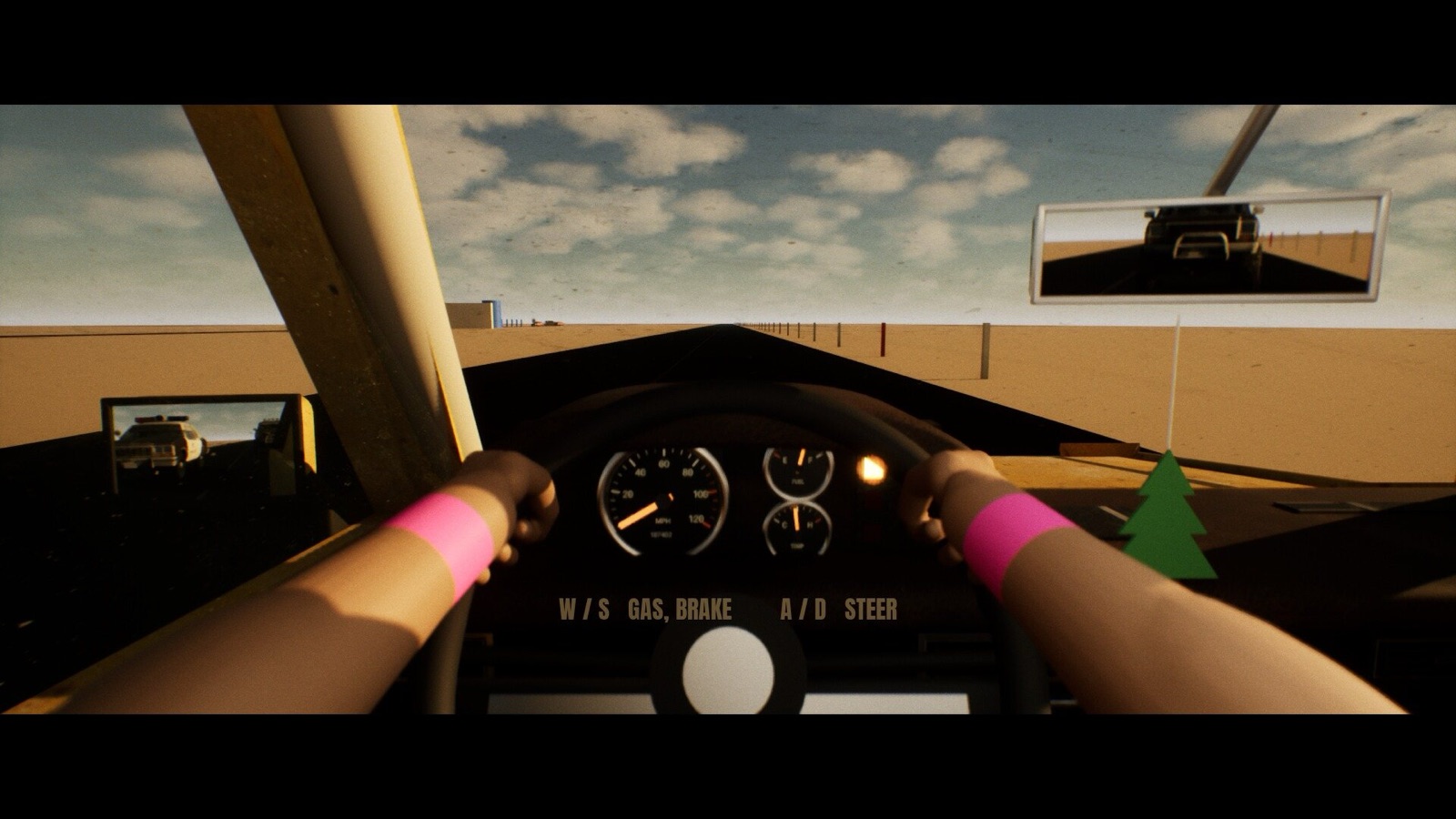
The first turn built the spine: a saved world state, a chapter framework, the diner's three doors, the whole town at its final layout, the film look (letterbox, grain, depth of field, a warm bloom on the neon), driving from a cockpit with live mirrors, and first person on foot with guns. The diner looked right. The rest of the town didn't, and the agent's own report said so: plain boxes for buildings.
Before any model was generated, the agent sent designs to approve: 13 people and 9 vehicles. I approved all 22 in one message. Then I forked the game for the first time. A second agent owned the town's look, with one rule: change how the town looks, but never move a door, a road or an anchor the gameplay depends on. The main project built the people, cars, guns and AI in the meantime, and split one of its own turns into four helpers to do it.
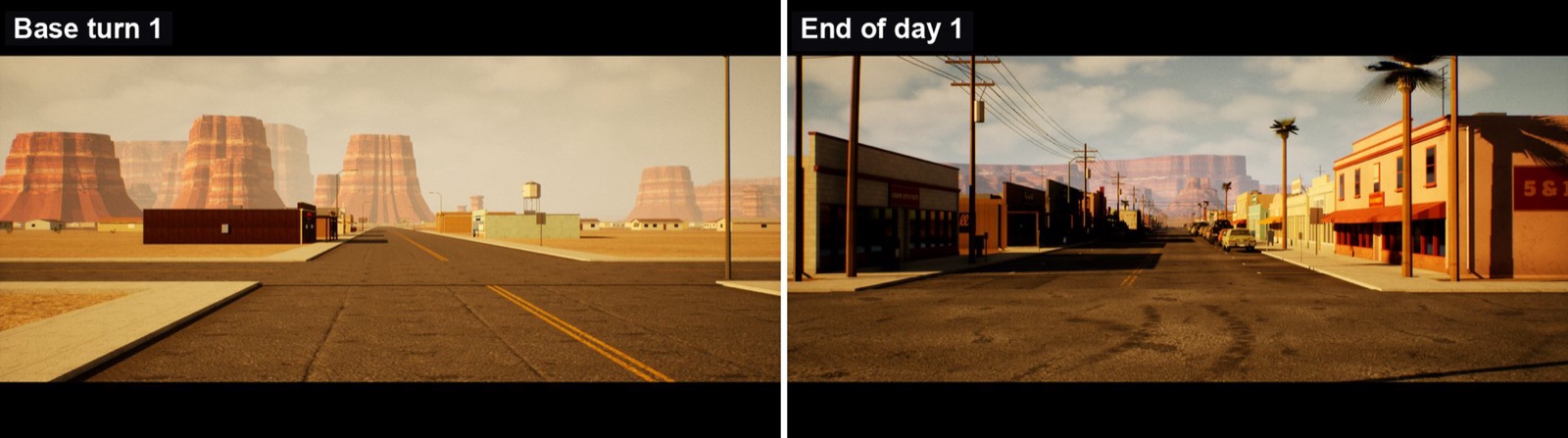
The town came back as about 3,300 files, and one turn proved every system on the merged town and wrote the result down line by line. Walking every interior, stealth in the market and the gas station explosion passed. The dirt bike, Dale's pickup chase and the bank firefight didn't yet.
Then I played it and found four things. The steering wheel turned the opposite way to the car, which was one sign in code every car shares. The title menu ignored the keyboard. Some characters and cars looked decimated in the web build, where the cars had kept as little as 15 percent of their triangles. And face animation didn't look good enough, so I tabled it for the jam: people speak through subtitles and their bodies, and scenes are framed to suit.
Day 2: five chapters at once
Five forks, five agents, five workstations. They went out in two waves, because three chapters depended on the pickup chase and the bank firefight, and those weren't reliable yet. The turn meant to fix them split itself into four helpers and ended with all four still working and nothing merged. The next turn found the four copies on the workstation's drive, merged them, and got the chase to 5 runs out of 5 and the firefight to 10 out of 10. Diego's and Rusty's chapters had forked before that; Lucy's, Johnny's and the Showdown forked after.
The Showdown's agent couldn't wait for the other four chapters to exist. It built its chapter against saved test states instead, one for each combination of who lived and what they arrived in, so it could be tested before there was anything to carry over.
The chapters turned out to be the best test the shared base ever had. Each fork wrote down what was wrong in the systems it wasn't allowed to edit, and the main project fixed them in rounds:
- Road lips. Every crossing in town had a lip of two or three centimetres. Cars hit one about every 200 metres and arrived wrecked. After the fix: 27 test drives, no damage.
- Cars resting low. Cars placed by the world state sat 20 to 34 cm too low and stalled on kerbs, which is why two chapters' packaged builds couldn't leave a driveway.
- People inside the seats. Passengers' heads were placed where the driving camera goes.
- The dirt bike. It shared its wheel setup with the cars and wrecked on every dirt road. It got its own.
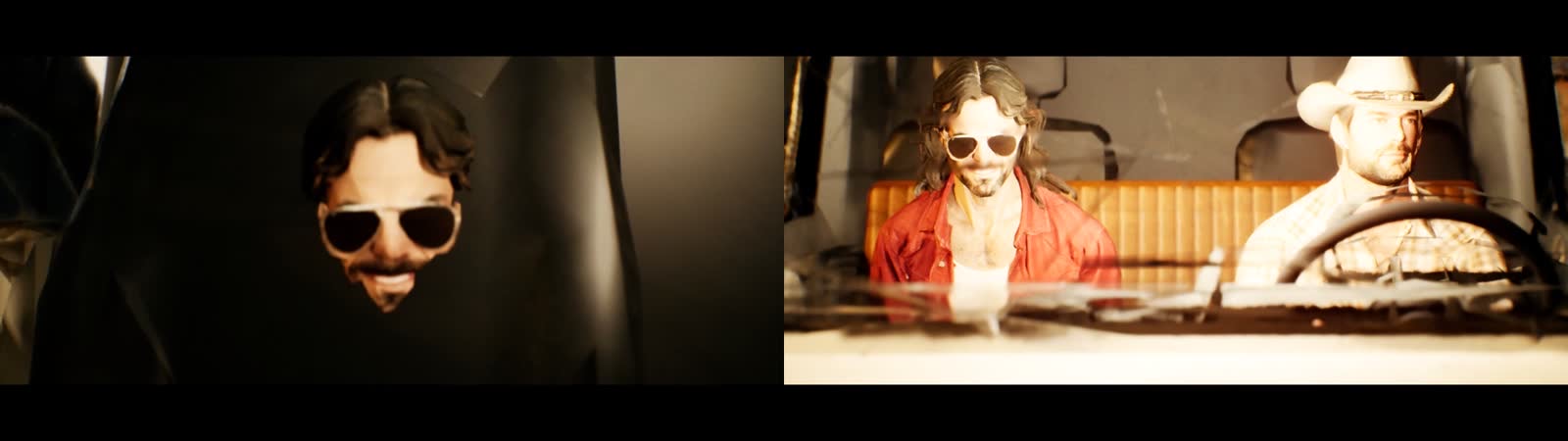
Whenever a fork went idle, I copied the base's fixes into it and its chapter back out, between turns. That evening every fork stopped, their folders went into the main project and the forks were retired. One merge turn made it one game: five chapters in order, every choice carried forward, each chapter's workarounds removed.
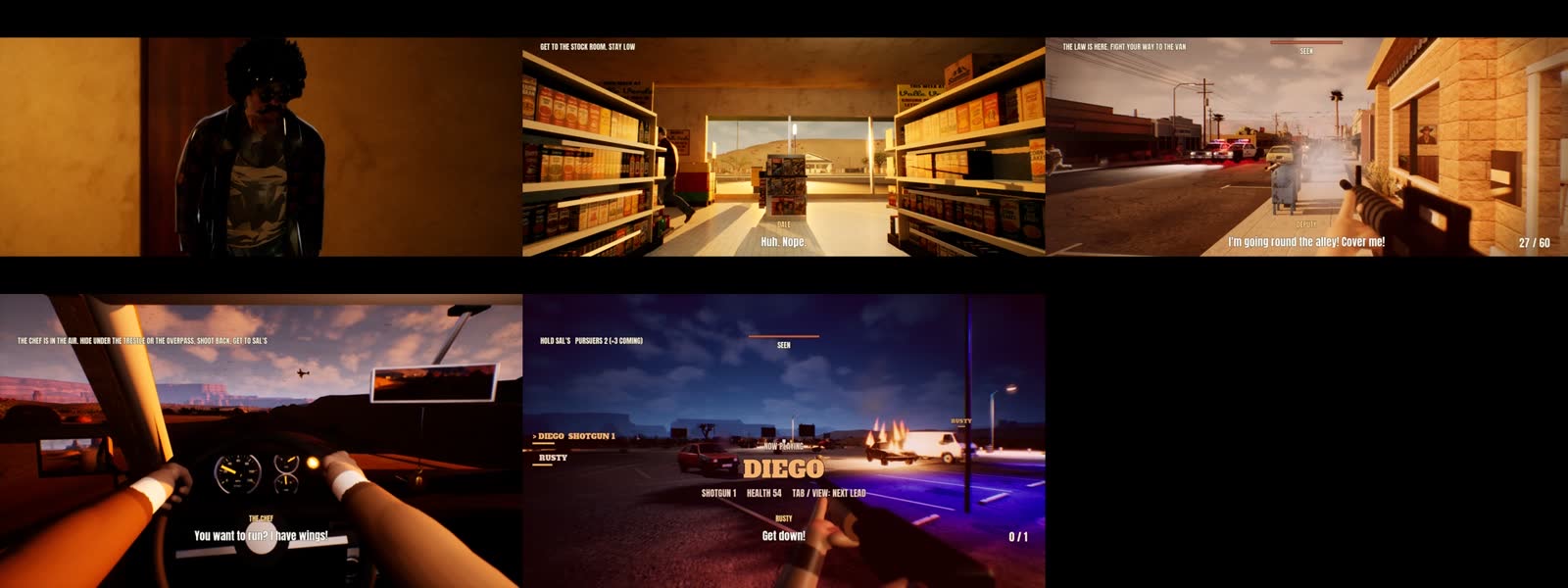
One chapter wouldn't end in the packaged build: chapter 4 drove to Sal's and stopped at the door. The game was fine. The chapter's test pilot was waiting for a line Nicole only says if she dies, and that time she'd survived.
Day 3: play-test and polish
From here there was one project. I played the build, wrote down what was wrong and sent it as turns: one long list overnight, seventeen notes in one sitting in the afternoon, then single notes back to back in the evening.
The overnight list came back with real findings. The web build had cut the ground mesh from about 1.5 million triangles to 2,238, which left a ridge across the road and nothing either side of it. Voice lines talked over each other 59 times across the game; after the turn, none did. Forty voice files began with up to half a second of silence. All 337 lines now play from start to end.
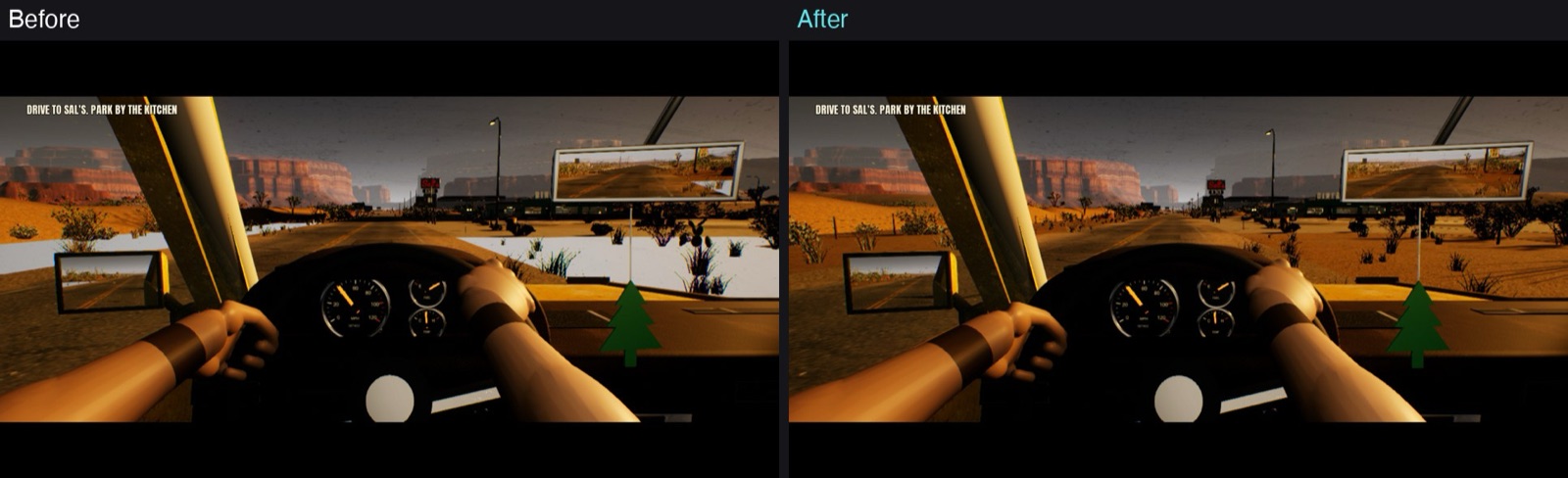
Some of the night's fixes went too far. The cars were 25% faster, and that was too fast. The mouse turned 2.7 times faster, and by day 4 that felt too fast as well. A refit of the hand on the rifle looked worse than the old one. Each got a short turn asking for exactly that change undone, with the numbers: the hatchback's 0 to 100 km/h went from 8.9 seconds to 7.2 and back to 8.85.
The fiddly parts, done by hand
Turns are long, and some decisions are quicker to make than to describe. So I built small web pages around the game's own models, made the calls there, and gave the results back to the agent as data.
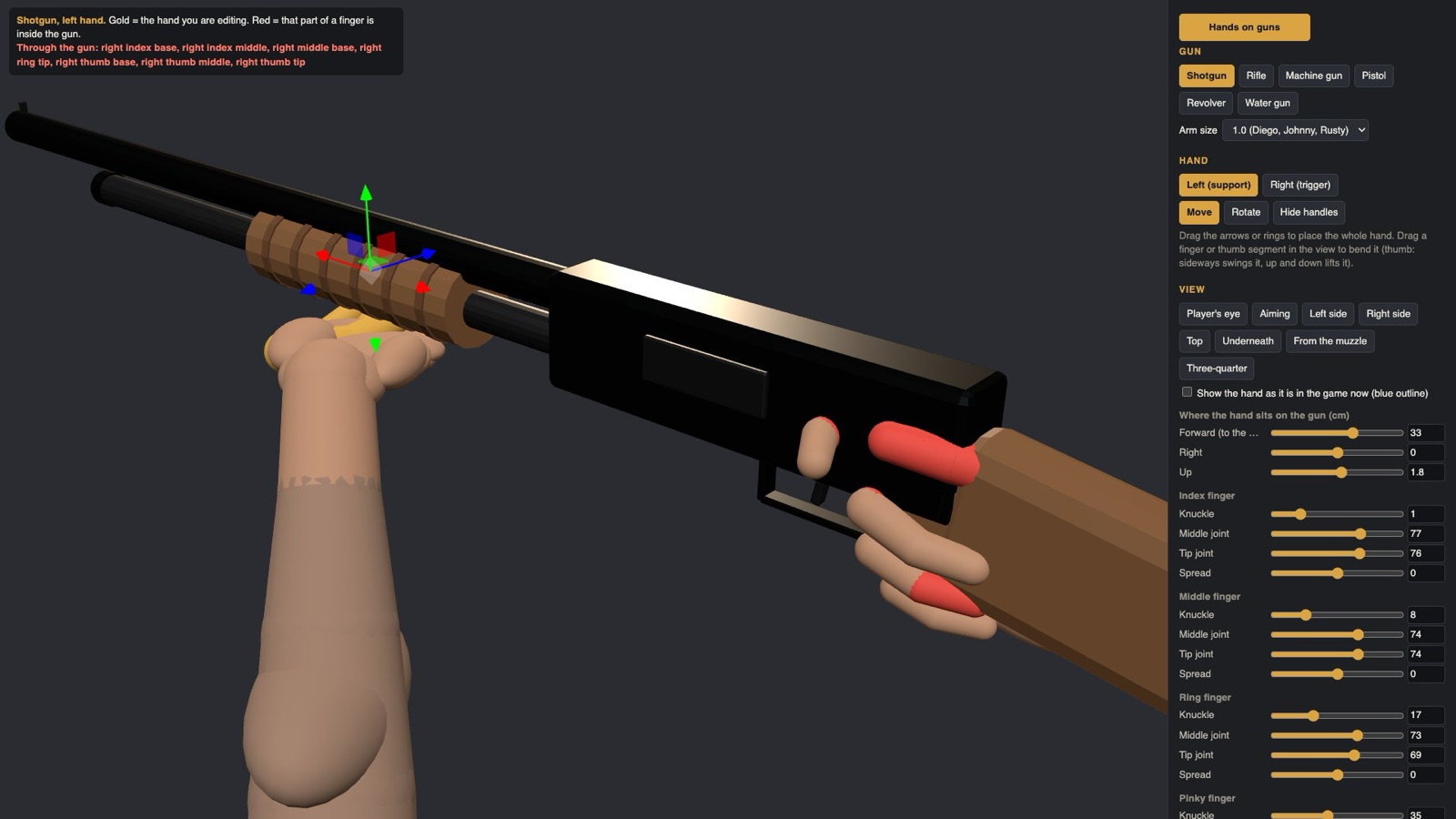
- Hands on guns. A page that puts the first-person hands on each gun. Drag the hand, bend each finger joint, and any part of a finger inside the gun turns red.
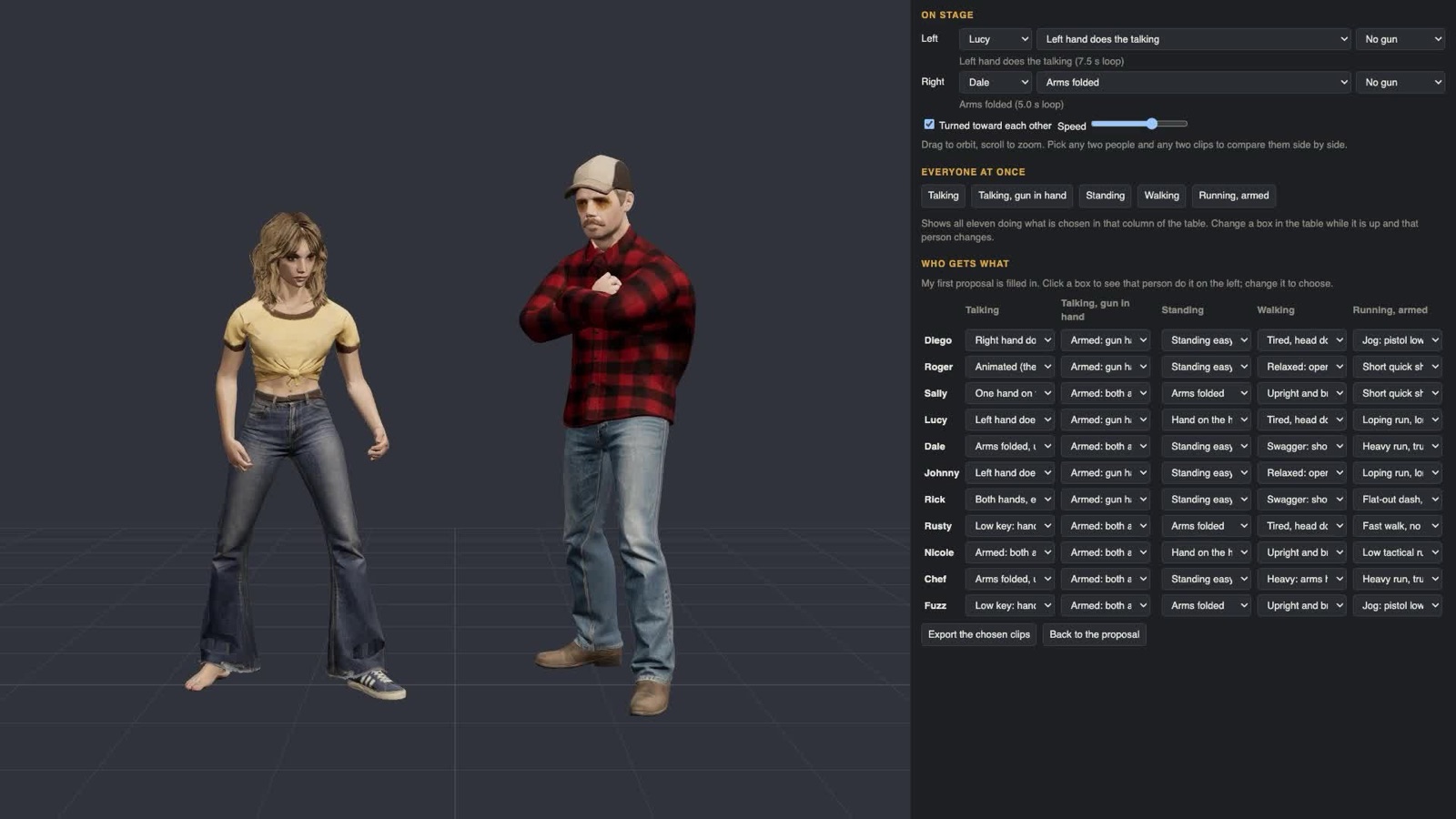
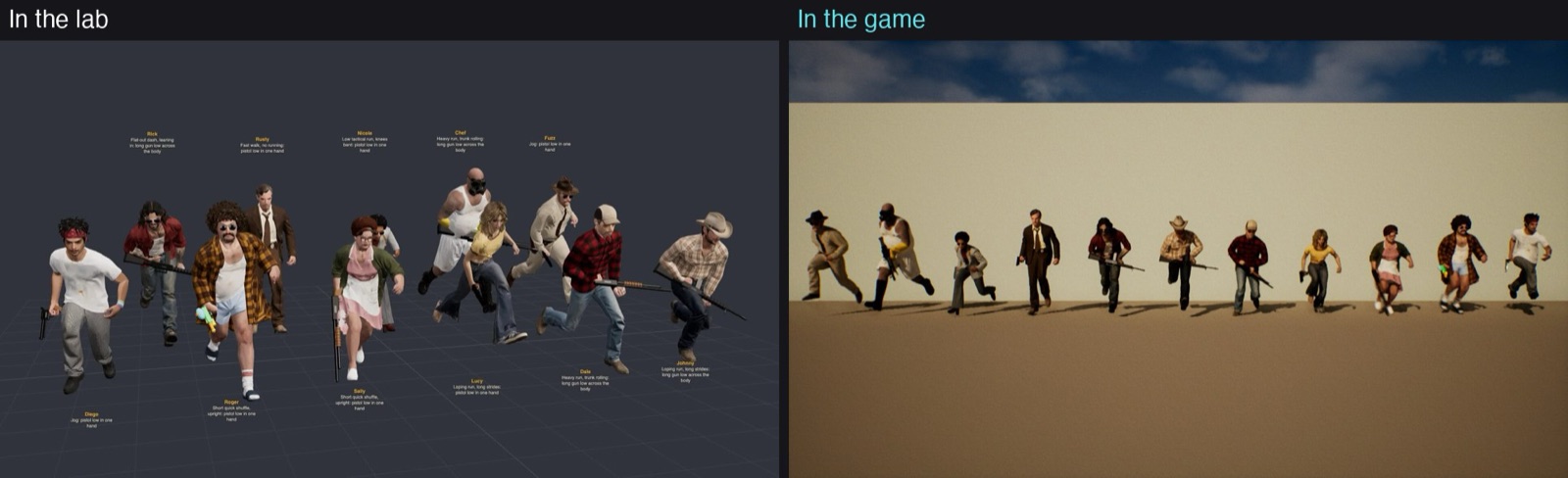
- An animation lab. All eleven characters on the game's rig, side by side. Everyone in the game talked with the same clip and ran with the same trot. I chose how each person talks, stands, walks and runs, and exported one file of 25 clips.
- Diego's voice. Three of his real lines read in nine voices on one page. I picked the fifth, and all 26 of his lines were recorded again.
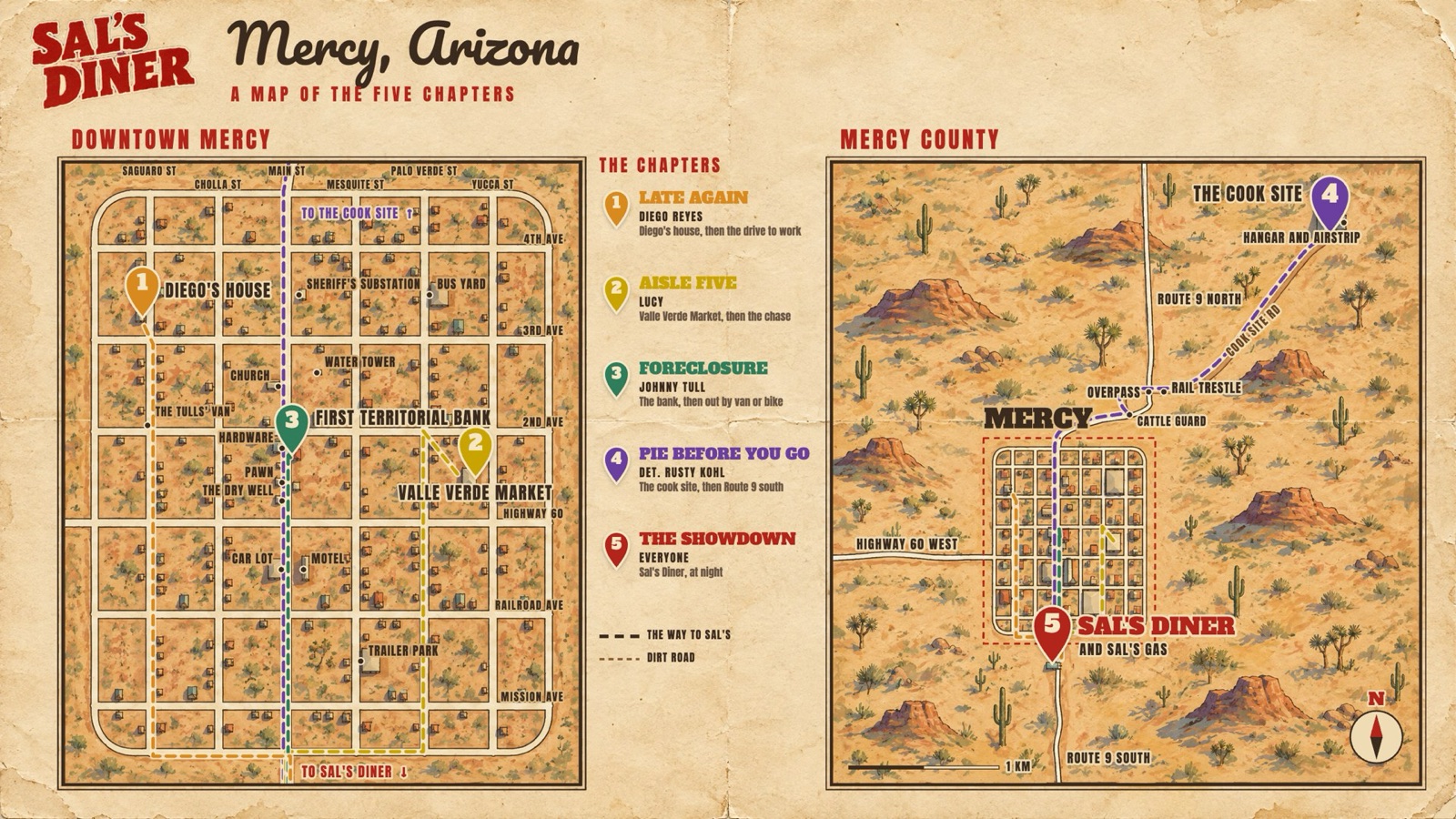
- A map of Mercy. Drawn from the game's own town data, with each chapter's route to the diner.
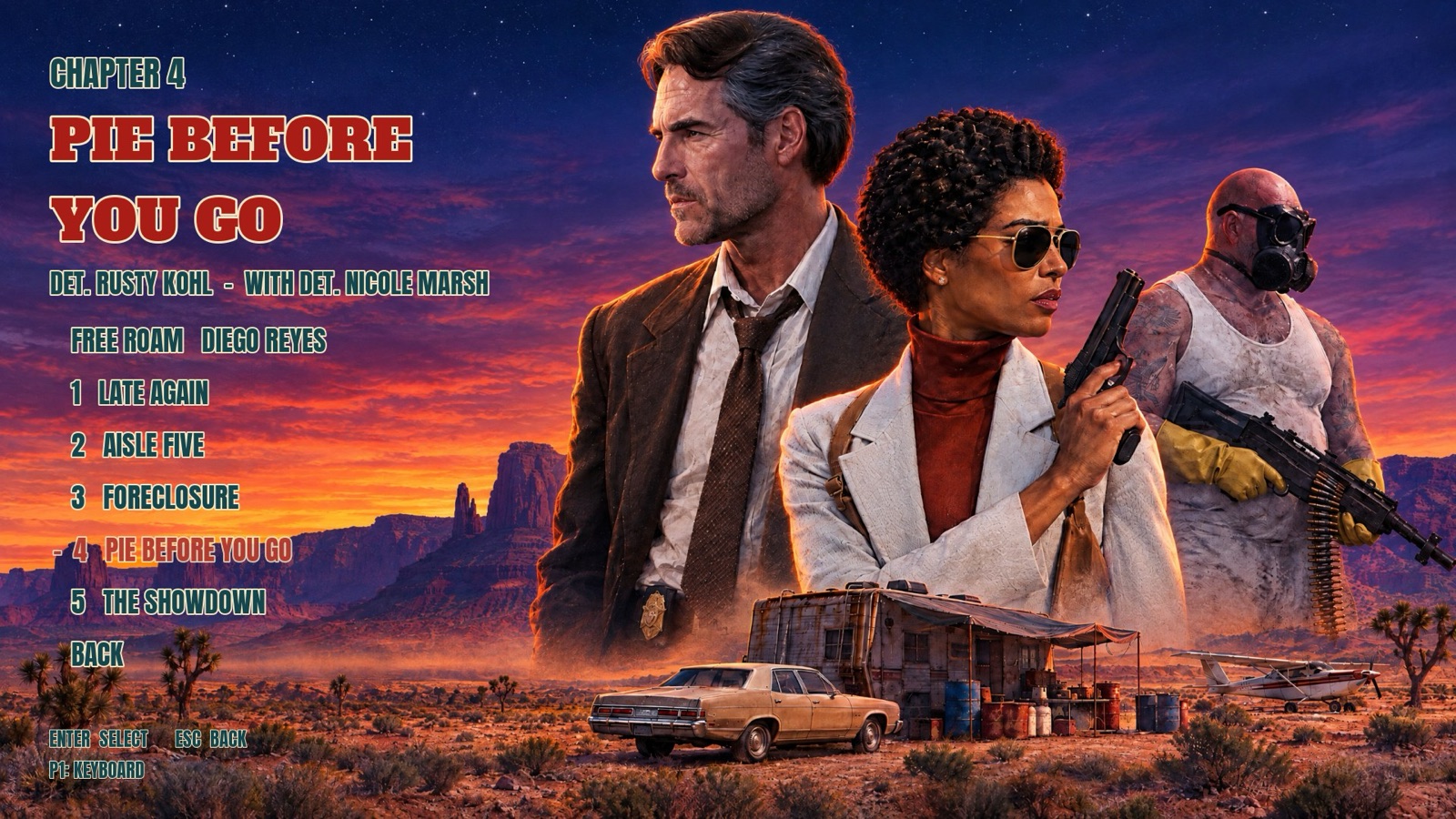
The menu art was made the same way, outside the game: a poster for the title screen and a card for each chapter, with the left 38% of each kept empty for the logo and the menu.
Day 4: ship it
Two last fixes went in overnight. The dirt bike hit a small bump, spun out and exploded: it balances on four hidden extra wheels, and one had caught the bump. And in chapter 1, Dale couldn't be killed however many times Diego shot him, because he was protected as chapter 2's pursuer. Now three revolver hits do it, a card reads "DALE WON'T BE COMING TO THE SHOWDOWN", and Lucy's chapter plays a quieter version.
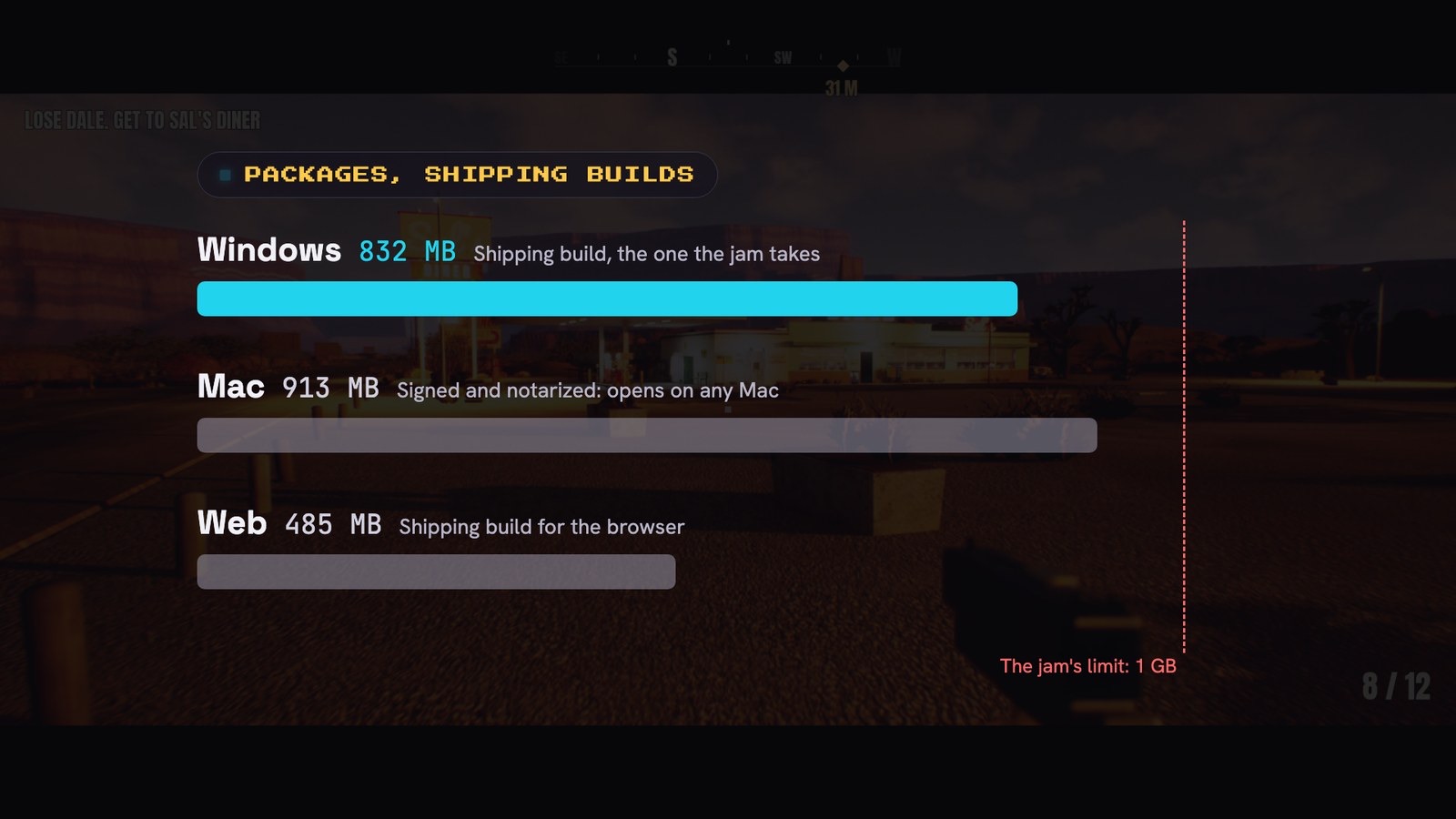
Then I stopped sending turns and packaged it:
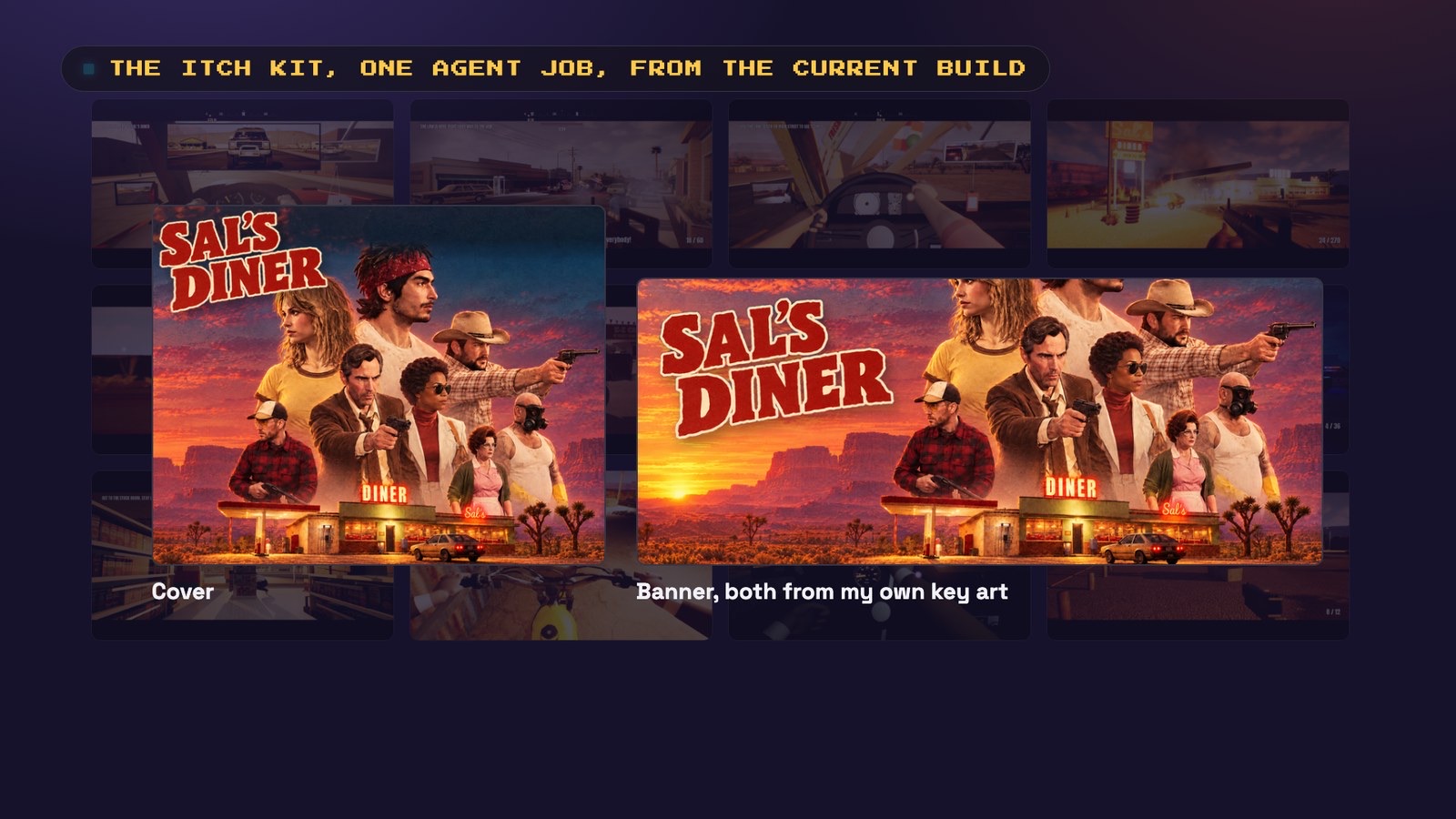
The itch page came from one marketing kit job on the finished build: twelve screenshots, six animated GIFs under itch's 3 MB cap, the cover, the banner, the logo and every field of the listing. The screenshots and GIFs are the game playing itself. The jam's 60-second video took three cuts. The first had captions and seventeen quick shots; I asked for no text and longer shots, then made the last cut myself.
What did four days add up to?
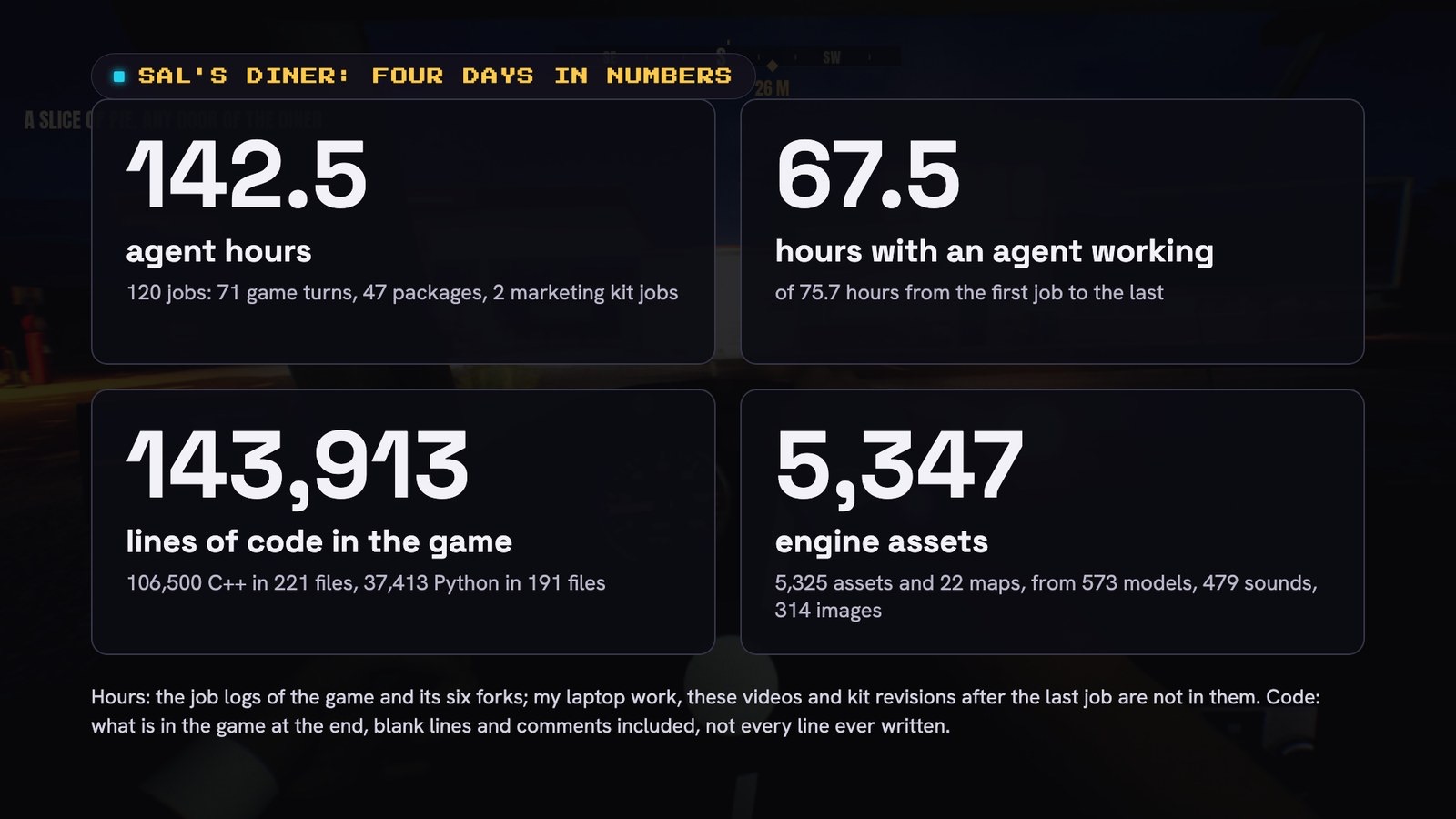
- 142.5 agent hours across 120 jobs: 71 game turns, 47 packages and 2 marketing kit jobs, on the game and its six forks.
- 67.5 hours with at least one agent working, out of 75.7 hours from the first job to the last. The gap between the two numbers is the forks running at the same time.
- 143,913 lines of code in the shipped game: 106,500 of C++ in 221 files and 37,413 of Python in 191 files. That counts blank lines and comments, and doesn't count code that was rewritten along the way.
- 5,347 engine assets, built from 573 models, 479 sounds and 314 images.
Not in those numbers: the work on a laptop (the hands page, the animation lab, the voices, the map, the posters), the Mac builds, the videos, and the hours spent playing it.
What went wrong?
- A turn ended with its helpers unfinished. Nothing was merged, and the next turn had to find their work and put it together.
- Disks filled up. One workstation's drive filled with another job's leftovers on day 2. Another ran out in the middle of the overnight list, because each helper had its own copy of the whole project.
- Fixes overshot. Car speed, mouse speed and the rifle hand all had to be walked back. "A little slow" isn't a number, and the agent picked one.
- The agents' checks passed things a person wouldn't. Faces inside seats, floating props and a finger through the rifle all survived every automatic check. As with Harrowgate, they were found by someone watching.
- Some fixes never met their bug. The agent's test of the bike fix took a different line out of the yard and never hit the bump.
- Nobody on the agent side can listen. The sound mix was measured and levelled, and judging it by ear was left to me.
- The web build is too big for itch. Its largest file is 369 MB and itch takes files up to 200 MB, so the browser version lives on the game's own page.
- The self-playing pilot lost the Showdown more often than it won: 13 wins to 18 losses across the merge turn.
What would I do again?
Write the contract first. The design bible is the reason five chapters built on five machines became one game in one merge turn. The rule that mattered most was the plainest one: you own your folders, and nothing else.
Don't fork until the shared parts work. Three chapters waited for the chase and the firefight to be reliable. Forking them earlier would have meant three agents each working around the same faults.
Have forks report faults, not fix them. Every base fix came from a chapter's written complaint, was made once, and reached every fork on the next sync.
Play it early, and by hand. None of day 1's four problems had been caught by an automatic check, and all of them showed up once a person sat down with a mouse. Notes with a picture and a number tended to be fixed in one turn. Notes with only an adjective, like "a little slow", were the ones that came back.
Make the small calls yourself. Where a finger sits on a shotgun is a ten-second decision with the model in front of you and a paragraph of guesswork without it. Handing the agent data instead of a description was the fastest loop of the week.
Where can you play it?
On its page on games.vbgnt.com, in a desktop browser with WebGPU (I test in Chrome). That's the Unreal 5.9 web build, which is experimental: it's a 485 MB download on a first visit, it uses Unreal's mobile renderer, and it doesn't run on phones. The Windows and Mac builds are on itch.io, and its jam entry is here.
The game was made with generative AI throughout: its code, models, textures, voices, music and sound effects, directed by a person and credited in the game. The four video diaries are also in the vbgnt YouTube series, Make Games with AI. Unreal is part of Professional in the studio, which is invite-only while it's being built.
Frequently asked questions
What is Sal's Diner?
Sal's Diner is a first-person crime game set in Mercy, Arizona, made for the 2026 Epic AI MegaJam. You play five chapters as five different leads, each ending at the door of the same roadside diner, and what you do in one chapter carries into the next. Everyone who survives fights the last chapter, the Showdown, together.
How was Sal's Diner made?
By AI agents in the vbgnt studio, on Unreal Engine 5.9, directed turn by turn from an assistant over MCP. Agents wrote the C++ and Python, generated and rigged the characters and vehicles, built the town, recorded the voices and music, and tested the game with self-playing pilots. A person wrote the design, played the builds, sent the fix notes and made some decisions by hand, such as hand poses and which animation each character uses.
How long did it take?
Four days, the length of the jam. The job logs show 142.5 agent hours across 120 jobs, with at least one agent working for 67.5 of the 75.7 hours between the first job and the last. Those numbers leave out the time spent playing the game and the work done by hand on a laptop.
How do several AI agents work on one Unreal game at the same time?
Each agent works on its own fork of the game on its own workstation. A shared design file sets the rules: a fork owns only its own folders, never saves shared assets, passes consequences through one shared world state, and writes down faults in shared systems instead of fixing them. Fixes to the base are copied into each fork between turns, and at the end the forks' folders are copied into the main project and one turn merges them.
Can I play Sal's Diner in a browser?
Yes, on its page on games.vbgnt.com, in a desktop browser with WebGPU such as Chrome. It is an Unreal Engine 5.9 web build, which Epic calls experimental: about 485 MB on a first visit, drawn with Unreal's mobile renderer, and not available on phones. Windows and Mac builds are on its itch.io page.
What went wrong during the jam?
A turn ended with its helper agents unfinished and nothing merged. Two workstations ran out of disk. Fixes for car speed, mouse speed and a hand pose overshot and had to be undone. The agents' automatic checks passed visual problems a person spotted quickly. And the web build's largest file was too big for itch.io's 200 MB file limit, so the browser version is hosted on the game's own page.